Mothers
Fetal Monitoring During Pregnancy Complete Guide for Mothers
Jul 10 • 8 min read
Table of Content
Key Takeaways
What Is Fetal Monitoring?
Why Monitoring Matters
When Is Fetal Monitoring Recommended?
Routine pregnancy
High-risk pregnancy
Global vs India Data Snapshot
Types of Fetal Monitoring: Quick Comparison
What Is a Normal Fetal Heart Rate?
Can You Track Your Baby's Movements at Home?
How to count kicks
Signs to Call Your Doctor Immediately
Myth vs. Fact
Frequently Asked Questions
Conclusion
When you are pregnant, the doctor will want to keep an eye on your baby. This is called monitoring. It checks your baby's fetal heart rate and movements to see how your baby is doing. It checks your baby's heart rate and movements to see if they are doing okay. There are ways to do this. You can do it at home by feeling your baby kick and using a device called a Doppler. You can go to the hospital and have something called an NST or CTG test.
A normal heart rate for a baby is between 110 and 160 beats per minute. If your baby's heart rate is not normal or if they are not moving much as they should be, you need to tell your doctor about it right away. So always tell your doctor if you notice any changes in fetal movements in pregnancy. Nearly half (49.4%) of pregnancies in India carry at least one high-risk factor, per a national analysis of NFHS-5 data covering over 23,800 pregnant women. (Journal of Global Health, 2023)
Pregnancy is a big deal, and it comes with a lot of little things to worry about. One of the big concerns for people who are pregnant is? Is my baby okay right now, today, between appointments? Fetal monitoring exists to answer exactly that question, and understanding how it works can turn anxiety into confidence.
Key Takeaways
According to ACOG, a normal fetal heart rate is between 110 and 160 beats per minute.
Fetal monitoring has a few parts to it, like Doppler and kick counts and something called NST and CTG and also ultrasound. Each of these things does something.
When a woman has a high-risk pregnancy, which can be because of diabetes or hypertension or twins or IVF or if she had a stillbirth before, then the doctors usually want to keep an eye on her.
If the baby is not moving much as it should, that is a big warning sign, and the doctor needs to do something about it right away.
There are some tools that women can use at home to check on their baby, and these tools can be reassuring. They do not replace the regular visits to the doctor when you are pregnant.
Some programs that help women count the kicks of their baby have been shown to work, and they can even help lower the number of stillbirths, and this is something that has been seen in real life.
What Is Fetal Monitoring?
Fetal monitoring is when doctors check on your baby's heart rate, movement, and how they react to contractions. This helps them see how well your baby is doing while in the womb.
Doctors do this by looking at your baby's heart rate, how much they move, and how their heart rate changes when your uterus contracts during labor.
A lot of parents wonder if fetal monitoring is for high-risk pregnancies. Not at all light monitoring occurs at nearly every visit, with additional monitoring for specific risk factors.
Severe bleeding (47%), pregnancy-related complications (19.6%), and infection or sepsis (12%) are the leading causes of maternal death in India. (JOGH, 2023)
India's maternal mortality ratio was 88 per 100,000 live births in 2023, translating to roughly 22,500 maternal deaths that year. (Data for India / SRS, 2023)
Why Monitoring Matters
WHO's guideline moved from a 4-visit model to a minimum of 8 antenatal care contacts, timed at weeks 12, 20, 26, 30, 34, 36, 38, and 40. (WHO / BJOG, 2017)
Monitoring is really important for doctors to see how the baby is doing. They want to know if the baby is getting oxygen and blood from the placenta. They also want to check on the baby's growth and development. Doctors use monitoring to look for signs of fetal distress. If they find something that does not look right, they might need to do tests like an ultrasound or a non-stress test to make sure the baby is okay. Monitoring helps doctors figure out if the baby needs testing.
Globally, an estimated 20 million pregnancies each year are classified as high-risk. (PMC survey review, 2024)
Common qualifying factors across guidelines: maternal age under 17 or over 35, gestational diabetes, hypertensive disorders, twin/multiple pregnancy, IVF conception, prior stillbirth or miscarriage, and pre-existing medical conditions. (PMC survey review, 2024)
Despite the guideline, only 13–23% of women in low- and middle-income countries currently receive 8+ ANC contacts, a real-world access gap that home monitoring and remote tools aim to help close. (Multi-country data review, 2025)
When Is Fetal Monitoring Recommended?
Routine pregnancy
Heartbeat checks at prenatal visits
Third-trimester growth assessments
Kick counting from week 28
High-risk pregnancy (monitoring often starts earlier, around week 26)
Gestational diabetes or high blood pressure
Twin or multiple pregnancy
IVF conception
Previous miscarriage or stillbirth
Reduced fetal movement or growth restriction
Post-term pregnancy (past 40–41 weeks)
Global vs India Data Snapshot
Metric | Global | India |
Stillbirth rate | 14.3 per 1,000 births (2023) | Higher than high-income-country average; exact national figure varies by source — verify current WHO/UNICEF country data before publishing |
High-risk pregnancy share | ~20 million pregnancies/year flagged high-risk | 20–49% of pregnancies, depending on definition/study |
Maternal mortality ratio | 211 per 100,000 live births (2017 baseline) | 88 per 100,000 live births (2023) |
Recommended ANC contacts | 8 minimum (WHO, since 2016) | Same WHO standard adopted nationally |
Types of Fetal Monitoring: Quick Comparison
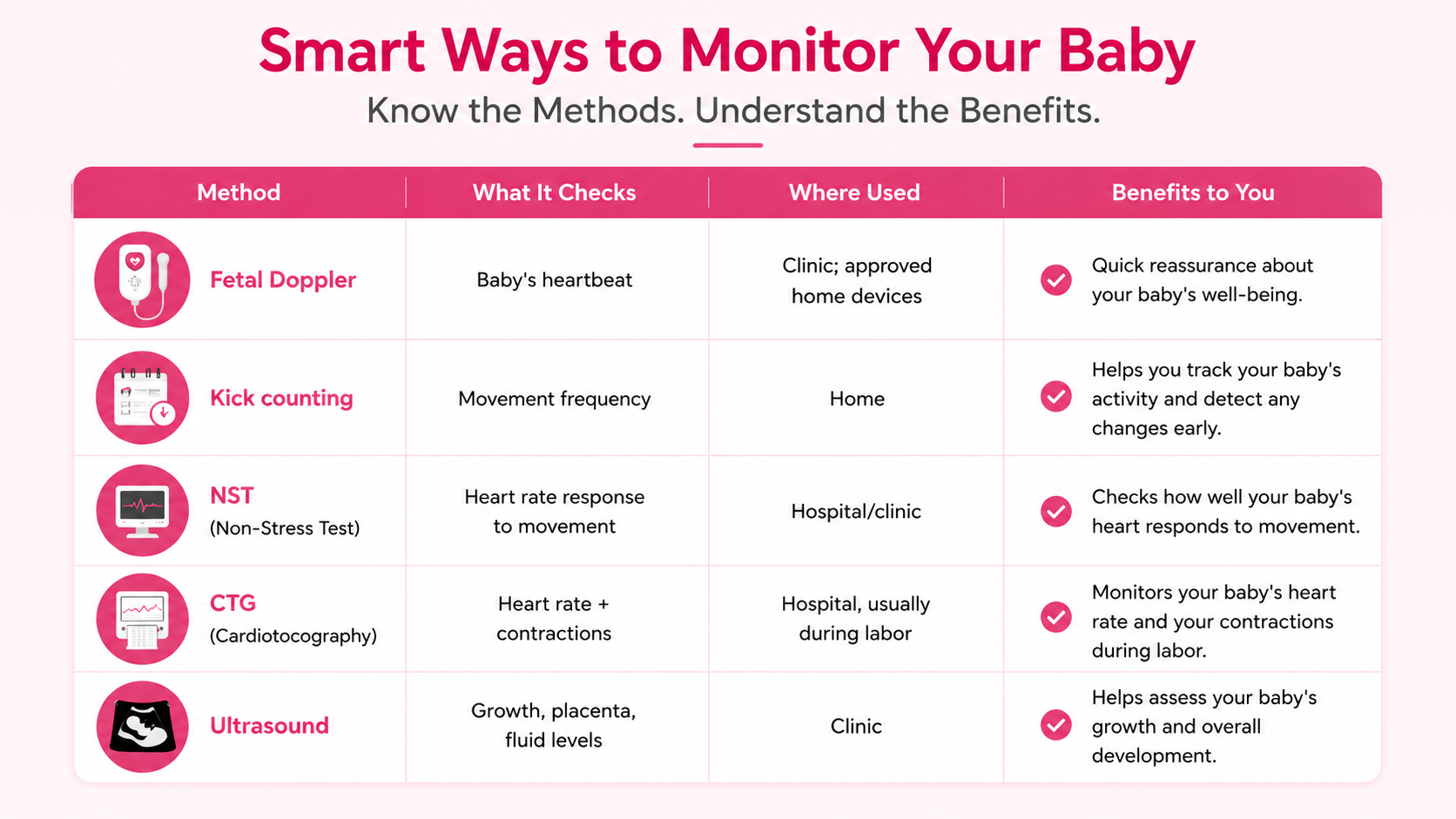
Method | What It Checks | Where Used |
Baby's heartbeat | Clinic; approved home devices | |
Kick counting | Movement frequency | Home |
Heart rate response to movement | Hospital/clinic | |
Heart rate + contractions | Hospital, usually during labor | |
Ultrasound | Growth, placenta, fluid levels | Clinic |
What Is a Normal Fetal Heart Rate?
As per ACOG and widely cited clinical data, a normal baseline fetal heart rate is 110–160 bpm throughout pregnancy. It runs faster early on, often near 170 bpm around 8–9 weeks, then gradually settles as the nervous system matures. A single high or low reading does not automatically mean there is a problem. Clinicians look at the pattern over a period of time.
Tachycardia is when the heart rate is above 160 beats per minute.
Bradycardia is when the heart rate is below 110 beats per minute.
A large retrospective study of nearly 79,000 cardiotocography tracings across three hospitals found a slightly narrower "best" normal range of 115–120 to 160 bpm, though the more commonly used clinical range remains 110–160 bpm. (PeerJ, 2013)
A healthcare provider, not self-diagnosed, should interpret any concerning reading.
Can You Track Your Baby's Movements at Home?
Yes, and it's one of the simplest, most evidence-backed things you can do. The American College of Obstetricians and Gynecologists says you should feel the baby move at least 10 times in 2 hours, and this is usually from the 28th week of pregnancy. The American College of Obstetricians and Gynecologists and the baby's movement are really important.
In Iowa, they have a program where they count the baby's kicks. This program found that the number of stillbirths went down by about 32 percent over ten years.
The American College of Obstetricians and Gynecologists and researchers think that if women are aware of the baby's movement, they might be able to prevent some stillbirths, and the baby's movement is the key to this.
How to count kicks:
Lie on your left side in a quiet spot.
Start a timer once you feel the first movement.
Track every kick, flutter, or roll — not hiccups.
Note how long it takes to reach 10.
Kick counting is one of the simplest ways to monitor your baby's well-being at home. From around 28 weeks, many healthcare providers recommend tracking your baby's usual movement pattern. Read our complete guide on How Many Baby Kicks Are Normal for detailed instructions.
This is exactly where continuous, connected monitoring tools add value. Janitris for Mothers App solutions are really helpful for mothers. These devices can help mothers keep track of their baby's heartbeat patterns when they are at home between visits to the doctor. If it is possible, mothers can even share the readings with their care provider. This way,y mothers can stay aware of what's going on with their baby without having to go to the doctor for every little thing... It is still important to go to the doctor for regular checkups.
Disclaimer: Using a device to monitor your baby at home can help you notice things and be more aware of what's going on. It does not take the place of going to see a doctor. You still need to have a medical evaluation, diagnosis, or treatment from a doctor. Janitris home fetal monitoring solutions and other devices like it are tools to help you stay informed about your baby's heartbeat patterns and other things.
Signs to Call Your Doctor Immediately
Noticeably reduced or absent fetal movement
I am worried about bleeding or fluid leakage. This is a deal for me.
I also have really bad abdominal pain.
Sometimes I get a headache, or I notice some vision changes.
What is going on with these contractions before 37 weeks of pregnancy? I mean, regular contractions before 37 weeks are really scary for me.
Fever
Myth vs. Fact
Myth | Fact |
A home Doppler means I can skip checkups | Home devices support, not replace prenatal care |
Babies naturally move less right before birth | Movement should stay consistent; a real drop needs a check-up |
One good heartbeat reading means everything's fine | Well-being depends on multiple factors tracked over time |
Kick counting is only for high-risk pregnancies | ACOG recommends it for all pregnancies from week 28 |
Fetal monitoring is painful | Doppler and kick counts are non-invasive and painless |
Frequently Asked Questions
Is fetal monitoring safe?
Yes, it is. Things like Doppler and kick counts and non-stress tests are all safe to do when you're pregnant.
When should you start counting the baby's kicks?
You should start doing this around week 28 of your pregnancy or week 26 if your pregnancy is considered high risk.
NST vs. CTG?
NST checks heart rate response to movement alone; CTG also tracks contractions, typically during labor.
Can't find the heartbeat at home?
Stay calm, change position, and call your provider; home devices can miss signals clinical equipment picks up.
Conclusion
Healthy pregnancies need check-ups with your doctor, knowing your baby's movements and monitoring when your doctor suggests it. Fetal monitoring helps you knowwhat'ss really going on with your baby, not just guessing. You can do a kick count at home or go to the clinic for a non-stress test. Tools like Janitris home monitoring solutions can give you peace of min, between doctor visits. They work best with a plan made with your healthcare provider, not replacing one.