Mothers
Why Continuous Monitoring Is Important in High-Risk Pregnancy
Apr 14 • 9 min read
Table of Content
What Is a High-Risk Pregnancy?
A high-risk pregnancy is one in which the mother, the fetus, or both face an elevated chance of complications before, during, or after delivery. According to the
Why Monitoring Cannot Be a One-Time Event
The Cost of Delayed Detection
Key Risks That Continuous Monitoring Can Detect Early
Preeclampsia and Hypertensive Disorders
What Does
The Role of
The Non-Stress Test (NST): What It Measures and Why It Matters
How an NST Works
How Janitri Supports Continuous Monitoring in High-Risk Pregnancies
Janitri's Fetal Doppler and NST Solutions
Janitri's
Labour Monitoring and Partograph Integration
Making Monitoring Accessible Across India
Frequently Asked Questions
References
Continuous monitoring in high-risk pregnancy means tracking the mother's vital signs and fetal heart rate in real time throughout pregnancy and labour. It helps detect dangerous complications; such as fetal distress, preeclampsia, or placental insufficiency; early enough to intervene and save lives. Tools like fetal Doppler devices and Non-Stress Tests (NST) are central to this monitoring.
What Is a High-Risk Pregnancy?
A high-risk pregnancy is one in which the mother, the fetus, or both face an elevated chance of complications before, during, or after delivery. According to the World Health Organization (WHO), approximately 15% of all pregnant women will develop a serious complication that requires skilled medical care.

A pregnancy may be classified as high-risk if the mother has:
Pre-existing conditions — diabetes, hypertension, thyroid disorders, heart disease, or kidney disease
Pregnancy-specific complications — gestational diabetes, preeclampsia, placenta previa, or intrauterine growth restriction (IUGR)
Multiple pregnancies — twins, triplets, or more
Advanced maternal age — pregnancies after the age of 35
Obstetric history — previous preterm births, stillbirths, or caesarean sections
Fetal abnormalities — detected chromosomal or structural conditions
Being classified as high-risk does not mean a complication will happen; it means the risk is elevated, and therefore the standard of care must be more vigilant. That vigilance translates directly into continuous, structured monitoring.
Why Monitoring Cannot Be a One-Time Event
One of the most common misconceptions in antenatal care is that a normal ultrasound or a normal blood pressure reading at one visit means everything is fine. In high-risk pregnancies, that is rarely sufficient.
Complications in high-risk pregnancies can develop rapidly and silently. Fetal heart rate patterns can change within minutes. Blood pressure can spike between appointments. Placental function can deteriorate over days without any visible symptoms.
This is precisely why continuous monitoring; rather than periodic check-ins, is the clinical standard for high-risk pregnancies in modern obstetric care.
The Cost of Delayed Detection
India records approximately 45,000 maternal deaths every year, with preeclampsia and birth asphyxia among the leading preventable causes (National Family Health Survey, NFHS-5). A significant proportion of these deaths and neonatal injuries are linked to late detection of warning signs that could have been caught with timely, structured monitoring.
Continuous fetal monitoring has been shown to reduce the incidence of neonatal seizures by approximately 50%, according to a Cochrane review of intrapartum electronic fetal monitoring studies. Early intervention is only possible when healthcare providers receive timely, accurate data, and that requires monitoring that doesn't stop between clinical visits.
Key Risks That Continuous Monitoring Can Detect Early
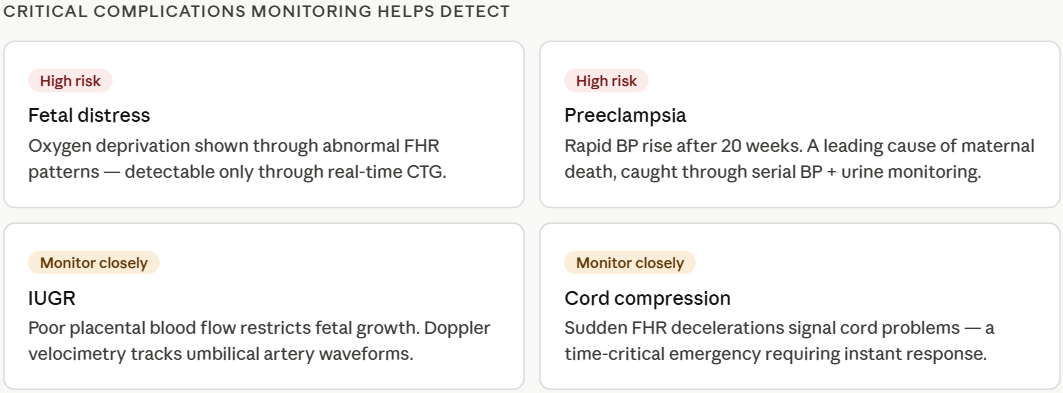
Below are the most serious complications in high-risk pregnancies that routine or continuous monitoring is designed to catch:
Fetal Distress
Fetal distress refers to signs that the fetus is not receiving adequate oxygen. It is identified through abnormal fetal heart rate (FHR) patterns; decelerations, tachycardia, or loss of variability. Without continuous FHR tracking, fetal distress can go undetected until it causes irreversible neurological damage.
Intrauterine Growth Restriction (IUGR)
IUGR occurs when the fetus does not grow at the expected rate inside the womb, often due to poor placental blood flow. Doppler ultrasound of the umbilical artery is the primary tool for monitoring blood flow and detecting IUGR progression early.
Preeclampsia and Hypertensive Disorders
Preeclampsia, characterised by high blood pressure and organ damage after 20 weeks of pregnancy, is one of the leading causes of maternal mortality globally. Regular blood pressure monitoring and urine protein screening are essential for catching it before it escalates to eclampsia.
Placental Insufficiency
When the placenta cannot deliver adequate oxygen and nutrients to the fetus, it leads to fetal hypoxia and growth problems. This cannot be diagnosed without active monitoring of fetal movements, heart rate, and blood flow patterns.
Preterm Labour
Continuous monitoring of uterine contractions and cervical changes helps identify the early onset of preterm labour, allowing timely administration of tocolytics and corticosteroids to improve fetal lung maturity.
Umbilical Cord Complications
Umbilical cord compression or cord prolapse causes sudden, severe fetal heart rate decelerations. These are time-sensitive emergencies that can only be detected through real-time fetal heart rate monitoring.
What Does Continuous Fetal Monitoring Include?
Continuous fetal monitoring in a high-risk pregnancy typically includes a combination of the following:
Monitoring Type | What It Measures | Frequency in High-Risk Pregnancies |
Fetal Doppler (CTG) | Fetal heart rate, uterine contractions | Weekly or as advised from 28 weeks |
Non-Stress Test (NST) | Fetal heart rate response to movement | Weekly or twice weekly from 32–36 weeks |
Biophysical Profile (BPP) | Fetal breathing, movement, tone, amniotic fluid, NST | As clinically indicated |
Doppler Velocimetry | Blood flow in umbilical/uterine arteries | In IUGR or placental insufficiency |
Blood Pressure Monitoring | Maternal systolic/diastolic BP | At every antenatal visit |
Kick Count / Fetal Movement Chart | Daily fetal activity tracking | Daily from 28 weeks onward |
These tools work together to create a comprehensive picture of maternal and fetal health — something no single test or single visit can provide.
The Role of Fetal Doppler for High-Risk Pregnancy
A fetal Doppler is a handheld or tabletop ultrasound device that uses sound waves to detect and amplify the fetal heartbeat. In clinical settings, it is integrated into cardiotocography (CTG) machines, which simultaneously record fetal heart rate (FHR) and uterine contractions on a printed or digital trace.
Fetal Doppler monitoring enables clinicians to:
Detect late decelerations, which indicate uteroplacental insufficiency
Identify variable decelerations, associated with cord compression
Confirm fetal heart rate variability, a sign of an active, well-oxygenated nervous system
Assess baseline FHR across different periods for trend analysis
In high-risk pregnancies, a reactive CTG trace where the FHR accelerates appropriately in response to fetal movement is a strong indicator of fetal well-being. A non-reactive trace requires further investigation.
The Non-Stress Test (NST): What It Measures and Why It Matters
The Non-Stress Test (NST) is one of the most widely used tools in antepartum fetal surveillance. Despite its name, it is not stressful for either the mother or the baby — it simply observes how the fetal heart rate responds naturally to fetal movement.
How an NST Works
During an NST:
1. The mother reclines comfortably in a semi-recumbent position
2. Two sensors are placed on the abdomen — one to record FHR, one to detect uterine contractions
3. The test runs for 20 to 40 minutes
4. The mother may press a button each time she feels the baby move
5. The trace is evaluated by a trained clinician or automated system
When Is NST Recommended?
NST is particularly important in high-risk pregnancies when:
Gestational diabetes is present
Maternal hypertension or preeclampsia has been diagnosed
IUGR has been detected
The mother reports decreased fetal movement
The pregnancy has extended beyond 40 weeks (post-term)
There is a history of stillbirth or previous pregnancy loss
Current obstetric guidelines (ACOG) recommend NST twice weekly for most high-risk conditions from 32–34 weeks of gestation onward.
How Janitri Supports Continuous Monitoring in High-Risk Pregnancies

Managing a high-risk pregnancy effectively requires not just the right clinical protocols, but also reliable, accessible technology that healthcare teams can trust — especially in tier-2 and tier-3 hospitals, district health centres, and midwife-led units across India.
This is exactly where Janitri plays a critical role.
Janitri's Fetal Doppler and NST Solutions
Janitri's fetal monitoring devices are designed to bring hospital-grade NST and fetal Doppler capabilities to healthcare facilities that may otherwise lack the infrastructure for continuous monitoring. The devices are built with Indian clinical environments in mind — robust, easy to use, and capable of generating interpretable CTG traces without requiring highly specialised training.
Key capabilities include:
Real-time FHR monitoring with accurate baseline and variability tracking
Uterine contraction recording to identify labour onset and patterns
Digital trace storage and transfer, enabling remote review and teleconsultation
Alert systems that flag abnormal FHR patterns for immediate clinical attention
Janitri's NST Monitoring Support
For antepartum surveillance, Janitri's platform supports the conduct and recording of Non-Stress Tests (NST) in a structured, reproducible format. The system helps clinical staff:
Set up and time NST sessions correctly
Record maternal button-press data alongside the FHR trace
Classify traces as reactive or non-reactive based on established criteria
Maintain digital records for longitudinal monitoring across the pregnancy
In high-risk pregnancies where NST needs to be performed weekly or twice weekly, having a streamlined digital workflow means fewer missed tests and more consistent surveillance.
Labour Monitoring and Partograph Integration
During labour, Janitri's platform integrates fetal heart rate monitoring with the digital partograph a labour progress chart that tracks cervical dilation, fetal descent, contractions, and maternal vitals. This integrated view gives the labour ward team everything they need in one place, reducing the risk of missed warning signs in the critical hours before delivery.
Making Monitoring Accessible Across India
One of the most significant challenges in Indian maternal healthcare is the inequitable distribution of monitoring technology. Urban tertiary hospitals are well-equipped; rural and semi-urban facilities often are not. Janitri's mission is to bridge this gap — ensuring that a mother delivering in a district hospital in Rajasthan receives the same quality of fetal monitoring as one delivering in a private hospital in Bengaluru.
By equipping more facilities with reliable, affordable fetal Doppler and NST monitoring tools, Janitri helps reduce the disparity in high-risk pregnancy outcomes across the country.
Frequently Asked Questions
What is the difference between intermittent auscultation and continuous fetal monitoring?
Intermittent auscultation involves listening to the fetal heartbeat for short intervals (typically 1 minute every 15–30 minutes in labour). Continuous fetal monitoring (CTG) records the fetal heart rate in real time throughout labour or a monitoring session, producing a trace that can be reviewed for patterns. In high-risk pregnancies, continuous monitoring is strongly preferred because complications can occur between intermittent checks.
Is continuous fetal monitoring safe for the baby?
Yes. Both external CTG monitoring and fetal Doppler devices use ultrasound waves and are non-invasive. There is no evidence that routine fetal monitoring causes any harm to the fetus. The risk of not monitoring a high-risk pregnancy consistently is far greater than any theoretical risk from the monitoring itself.
How often should a high-risk pregnant woman have an NST?
Most obstetric guidelines recommend NST once or twice weekly from 32–36 weeks onward in high-risk pregnancies, though the frequency depends on the specific condition. A doctor managing a pregnancy with severe IUGR or uncontrolled gestational diabetes may recommend more frequent testing.
Can I monitor my baby's heartbeat at home?
Consumer-grade fetal Dopplers are available for home use, but they are not a substitute for clinical-grade CTG monitoring. Home devices cannot record a trace, detect decelerations, or measure uterine contractions. If you have a high-risk pregnancy, clinical monitoring under medical supervision is essential.
What does a non-reactive NST mean?
A non-reactive NST means the fetal heart rate did not show the expected accelerations during the test period. This does not automatically mean the baby is in danger — the fetus may be in a sleep cycle. The test is usually extended to 40 minutes. If still non-reactive, further testing (Biophysical Profile, Contraction Stress Test) is performed to assess fetal well-being.
Key Takeaways
High-risk pregnancies require continuous, structured monitoring because complications can develop rapidly and silently between standard antenatal visits.
The two most important tools for antepartum fetal surveillance are the fetal Doppler (CTG) and the Non-Stress Test (NST).
Fetal Doppler monitors real-time heart rate patterns and detects life-threatening complications like cord compression and placental insufficiency.
NST evaluates fetal well-being by assessing how heart rate responds to movement — a reactive NST is a strong indicator of fetal health.
During labour, continuous electronic fetal monitoring is the standard of care in high-risk pregnancies and significantly reduces rates of neonatal injury.
Janitri's fetal monitoring solutions — including digital CTG, NST support, and partograph integration — are making high-quality continuous monitoring accessible across healthcare facilities in India, helping close the gap in maternal and neonatal outcomes.
References
1. World Health Organization. (2023). Maternal Mortality: Key Facts. WHO Global Health Observatory.
2. Alfirevic Z, Devane D, Gyte GML. (2017). Continuous cardiotocography (CTG) as a form of electronic fetal monitoring (EFM) for fetal assessment during labour. Cochrane Database of Systematic Reviews.
3. American College of Obstetricians and Gynecologists (ACOG). (2021). Antepartum Fetal Surveillance. Practice Bulletin No. 229.
4. National Family Health Survey (NFHS-5). (2021). India Fact Sheet. Ministry of Health and Family Welfare, Government of India.
5. Royal College of Obstetricians and Gynaecologists (RCOG). (2022). Green-top Guideline No. 31: The Investigation and Management of the Small-for-Gestational-Age Fetus.
6. Liston R, Sawchuck D, Young D. (2018). Fetal Health Surveillance: Antepartum and Intrapartum Consensus Guideline. SOGC Clinical Practice Guideline.