Mothers
How Many Baby Kicks Are Normal?
Jul 9 • 8 min read

Table of Content
Is There a Number of Baby Kicks?
Is There a Normal Number of Baby Kicks?
When should you start counting the kicks of your baby?
What Counts as a Baby Kick?
How to Count Baby Kicks
Step 1: Choose the Right Time
Step 2: Get Comfortable
Step 3: Count Every Movement
Step 4: Record Your Count
Understanding the 10 Kicks in 2 Hours Guideline
What If My Baby Isn't Moving as Much Today?
Can You Make Your Baby Move?
Common Mistakes When Counting Baby Kicks
Comparing Your Baby with Others
Focusing Only on the Number
Counting Only Strong Kicks
Waiting Too Long
When Should You Contact Your Healthcare Provider?
Track Baby Kicks with the Janitri Fetal Movement (JFM) App
Frequently Asked Questions
Is 10 baby kicks in 2 hours normal?
Do rolls and stretches count as baby kicks?
Should I count baby kicks every day?
Does an anterior placenta affect baby kicks?
Can I use a home Doppler instead of counting baby kicks?
Is it normal for babies to have quiet days?
Conclusion
Feeling your baby move is a good sign when you are pregnant. It is nice to feel those kicks and movements. They tell you that your baby is doing well. As your pregnancy goes on you might wonder if your baby is moving enough. You might think about how many kicks you should feel in a day.
The thing is, there is no one number of kicks that is normal for all pregnancies. Every baby moves in their way. It is better to pay attention to what's normal for your baby. Understanding fetal movements in pregnancy can help you recognise what's normal and when to seek medical advice.
In this guide you will learn about baby kicks and what's normal. You will find out when you should start counting kicks, how to keep track of your baby's movements and when you should go see a doctor.
Key Takeaways
Kick counting is usually recommended from 28 weeks of pregnancy is high-risk pregnancy.
There isn't one fixed number of baby kicks that's normal for every baby.
Kicks, rolls, stretches and swishes all count as baby movements.
Your baby's usual movement pattern matters more than reaching a specific number.
Contact your healthcare provider if you notice a significant reduction in your baby's movements.
Is There a Number of Baby Kicks?
One of the common questions expecting parents ask is, how many baby kicks are normal. The answer is that there is no number for baby kicks.Every baby has a movement pattern.
Some babies are naturally more active.Others have quieter but consistent routines.Both can be perfectly healthy.
Healthcare providers often recommend becoming familiar with your baby's pattern.They suggest you focus on this or the number of movements.A sudden change in your baby's activity is usually more important. This is more important than comparing your baby kicks with someone's baby kicks.
Is There a Normal Number of Baby Kicks?
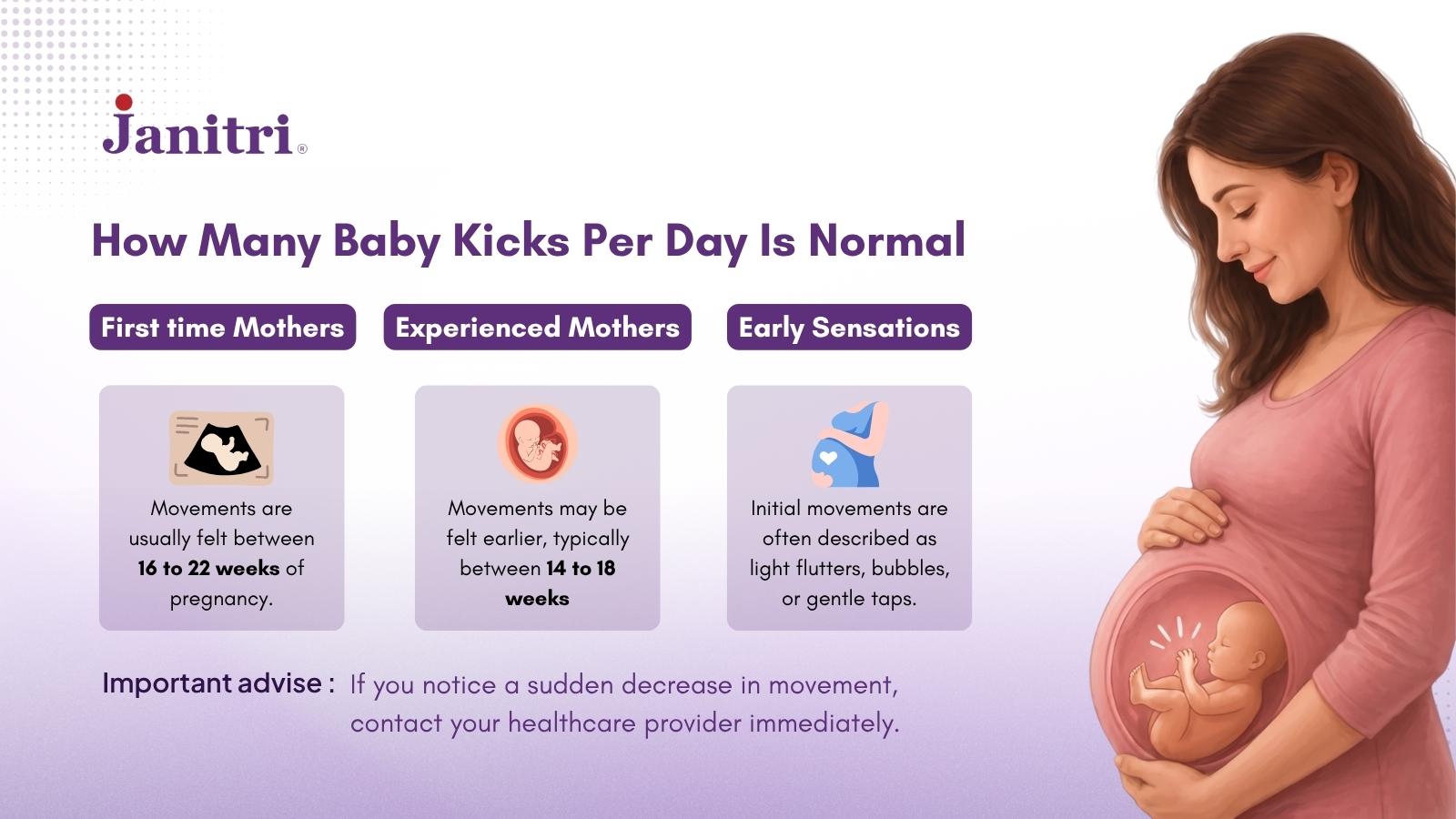
One of the most common questions expecting parents ask is, "How many baby kicks are normal?" The answer is that there's no universal number.
Every baby has a unique movement pattern. Some babies are naturally more active, while others have quieter but consistent routines. Both can be perfectly healthy.
Healthcare providers often recommend becoming familiar with your baby's usual pattern instead of focusing only on the number of movements. A sudden change in your baby's normal activity is usually more important than comparing your kick count with someone else's.
A commonly used guideline is feeling 10 movements within two hours during your baby's usual active time. However, many healthy babies reach 10 movements much sooner.
When should you start counting the kicks of your baby?
You should start counting the kicks of your baby from around 28 weeks of pregnancy. At this point your baby usually has a regular sleep and wake cycle so the movements of your baby are easier to notice.
If you have a high risk pregnancy the person who takes care of your health may tell you to start monitoring the movements of your baby
Do not just count the kicks of your baby, sometimes try to pay attention to what your baby does every day. Knowing when your baby is usually active can help you see if there are any changes in the kicks of your baby.
What Counts as a Baby Kick?
Despite the name, kick counting includes more than just kicks.These are all normal fetal movements and should be counted.
These include:
Kicks
Rolls
Stretches
Punches
Jabs
Swishes
As your baby grows, movements may change from sharp kicks to stronger rolls and stretches because there's less room inside the uterus. These movements are completely normal and should still be counted.
How to Count Baby Kicks
Kick counting is a simple way to become familiar with your baby's normal movement pattern. It only takes a few minutes each day and doesn't require any special equipment.
Step 1: Choose the Right Time
Pick a time when your baby is usually active, such as after a meal or in the evening. Try to count your baby's movements at a similar time each day.
Step 2: Get Comfortable
Sit comfortably or lie on your left side. This position may help you notice your baby's movements more easily.
Step 3: Count Every Movement
Count every kick, roll, stretch, jab or swish until you've felt 10 movements.
Step 4: Record Your Count
Many healthy babies reach 10 movements within 30 to 60 minutes, although taking up to two hours can still be normal. The goal isn't to finish quickly—it's to become familiar with your baby's usual movement pattern.
Understanding the 10 Kicks in 2 Hours Guideline
You may have heard that you should feel 10 baby movements within two hours. This is a commonly used guideline to help monitor your baby's well-being during the third trimester.
However, it's important to remember that this isn't a strict rule for every pregnancy. Many healthy babies reach 10 movements well before two hours, while others naturally have different activity patterns.
Instead of focusing only on the number of kicks, pay attention to whether your baby's movements feel similar to their usual routine. If you notice a A sudden reduced fetal movement should never be ignored, contact your healthcare provider promptly.
Kick counting is a helpful way to become familiar with your baby's normal movement pattern. Rather than comparing numbers, focus on recognising what's usual for your baby and seek medical advice if you notice a significant change.
What If My Baby Isn't Moving as Much Today?
It's common for parents to worry if their baby seems quieter than usual. Before assuming something is wrong, remember that babies have their own sleep and wake cycles. They may sleep for 20–40 minutes, and occasionally for up to 90 minutes, during which you may notice fewer movements.
Sometimes movements can also feel different because:
Your baby has changed position.
You're busy or active and haven't noticed movements.
You're approaching the end of pregnancy, where movements become more like rolls and stretches than sharp kicks.
However, if your baby's movements are significantly less than their usual pattern, don't wait for them to become active again. Contact your healthcare provider for advice as soon as possible.
Can You Make Your Baby Move?
Many parents try different methods if they haven't felt their baby move for a while. You may have heard suggestions such as:
Drinking cold water.
Having a snack or something sweet.
Lying on your left side.
Sitting quietly and focusing on movements.
While some parents notice their baby is more active after eating or resting, these methods don't reliably assess your baby's well-being.
If you're worried because your baby's movements are reduced or different from normal, don't rely on home remedies. It's always safest to speak with your healthcare provider.
Common Mistakes When Counting Baby Kicks
Kick counting is simple, but these common mistakes can lead to unnecessary worry or delay getting medical advice.
Comparing Your Baby with Others
Every baby has a different movement pattern. Comparing your kick counts with someone else's pregnancy isn't helpful.
Focusing Only on the Number
Reaching 10 movements doesn't always mean everything is normal if your baby's activity is much lower than usual. The overall pattern matters more.
Counting Only Strong Kicks
Rolls, stretches and punches are all normal movements and should be included in your count.
Waiting Too Long
If your baby's movements are noticeably reduced, don't wait until the next day to see if they improve. Early assessment is always the safest option.
When Should You Contact Your Healthcare Provider?
Knowing when to seek medical advice is one of the most important parts of monitoring your baby's movements.
Contact your healthcare provider immediately if:
Your baby is moving significantly less than usual.
You notice a sudden change in your baby's normal movement pattern.
You don't feel movements during your baby's usual active time.
You're worried about your baby's movements, even if you're unsure why.
Your doctor may perform a Non-Stress Test (NST) or Cardiotocography (CTG) to assess your baby's well-being.
It's always better to have your baby assessed than to stay at home worrying. In many cases, everything is reassuring, but prompt assessment helps ensure the best care for both you and your baby.
Track Baby Kicks with the Janitri Fetal Movement (JFM) App
Keeping track of your baby's movements every day isn't always easy, especially with a busy schedule. The Janitri Fetal Movement (JFM) App helps you record daily baby movements, monitor movement trends over time and maintain a digital record that can be shared with your healthcare provider.
The app is designed to help you recognise your baby's usual movement pattern more easily. It supports your pregnancy journey but does not replace regular prenatal care or medical advice.
Frequently Asked Questions
Is 10 baby kicks in 2 hours normal?
Yes. This is a commonly used guideline during the third trimester. Many healthy babies reach 10 movements much sooner. What's more important is becoming familiar with your baby's usual movement pattern.
Do rolls and stretches count as baby kicks?
Yes. Kicks, rolls, stretches, punches, jabs and swishes all count as fetal movements.
Should I count baby kicks every day?
If your healthcare provider recommends kick counting, try to monitor your baby's movements at a similar time each day from around 28 weeks of pregnancy.
Does an anterior placenta affect baby kicks?
Yes. An anterior placenta can cushion your baby's movements, making them feel softer, especially earlier in pregnancy. You should still become familiar with your baby's normal movement pattern.
Can I use a home Doppler instead of counting baby kicks?
No. A home Doppler can detect your baby's heartbeat, but it cannot assess your baby's overall well-being or replace medical assessment if you're concerned about reduced movements.
Is it normal for babies to have quiet days?
Babies have natural periods of sleep and rest, but they shouldn't suddenly become much quieter than their usual pattern. If you notice a significant reduction in movements, contact your healthcare provider promptly.
Conclusion
There is no one number of baby kicks for every pregnancy. Each baby kicks in their way and it is good to know what is normal for your baby. This way you can see if your baby is doing well. Your baby kicks in a way and you get to know this over time. If you notice that your baby is not kicking much as they usually do or if the kicks feel different you should talk to your doctor.
It is an idea to talk to your doctor if you are worried about your baby's kicks. The doctor can check on your baby. Make sure everything is okay. This can be a relief for you and it helps your doctor give you and your baby the best care.
Reading: Do you want to know more about how your baby moves during pregnancy? You can read our guide on Fetal Movements in Pregnancy: What's Normal, When to Worry & When to Seek Medical Care to learn about the different ways your baby moves.