Mothers
Why Do Babies Get a Fever After Vaccination?
Jul 24 • 6 min read
Table of Content
Why Do Babies Get Fever After Vaccination?
Which Vaccines Commonly Cause Fever?
Is Fever After Vaccination Good or Bad?
How Many Days Does Fever Last After Vaccination?
What Not to Do After Vaccination
Myth vs Fact
When to Call the Doctor
Keep Track of Your Baby's Temperature with Confidence
Why Parents Choose Navam TempLive
Conclusion
Babies get a fever after they get a vaccination because their immune system is working to build protection against a disease. When the vaccine is given to the baby, the white blood cells in the baby's body start to respond to the vaccine. The baby's body temperature goes up a bit.
This is what happens to babies after they get a vaccination. The fever is usually not very bad. It goes away on its own within one to three days. Fever after vaccination is something that happens to a lot of babies. It is not very serious.
Let us talk about why baby fever after they get a vaccination, how long the fever lasts, and what you can do to help your baby feel better.
Key Takeaways
When your child gets a fever after they get vaccinated, it means their immune system is doing what it is supposed to do. It does not mean something is wrong.
A lot of kids one in five get a mild fever after they get some of the common vaccines when they are little. This is what doctors see at hospitals.
The fever usually starts a few hours after the vaccine, and it can last for a few days.
Some vaccines, like the DTaP vaccine, the Hib vaccine, and the pneumococcal conjugate vaccine, are more likely to cause a fever than other vaccines.
If your baby is really young, under two or three months old, and they get a fever after a vaccine, you should take them to see a doctor.
You can check your child's temperature at home to see what is going on without getting too worried.
It is important to remember that a fever from a vaccine is not the same as a fever from being sick. The reason for the fever is what matters.
Why Do Babies Get Fever After Vaccination?
The simple version is that a vaccine has a part of a virus or bacteria that is not strong or it is not active. A vaccine contains this part of a virus or bacteria, so it does not hurt us. A vaccine is like this because it has a piece of a virus or bacteria that is weak or not working.
Your baby's immune system spots it.
It sends white blood cells to "learn" how to fight it.
This process releases proteins that slightly raise body temperature.
Fever is the visible sign of invisible protection being built. The Children's Hospital of Philadelphia's Vaccine Education Centre notes that a fever after vaccination is actually evidence the immune system is responding as expected.
What Is a Fever?
A fever is a body temperature higher than the normal range of about 98.6°F (37°C). In babies, doctors usually define fever as a temperature of 100.4°F (38°C) or higher.
Which Vaccines Commonly Cause Fever?
Vaccine | When Fever Usually Starts | How Common |
DTaP (Diphtheria, Tetanus, Pertussis) | Within 12–48 hours | Common, mostly mild |
Hib (Haemophilus influenzae) | 6–48 hours | Varies by brand (1–19%) |
Pneumococcal (PCV13) | Within 7 days | 24–35% in infants |
Hepatitis B | 1–17 days | Around 2% |
OPV/IPV (Polio) | Rare | Uncommon |
BCG | Very rare | Uncommon |
Rotavirus (oral) | Within days | Mild, uncommon |
MMR (measles component) | 6–12 days after | About 10% |
Data compiled from CDC and Children's Hospital of Philadelphia vaccine safety resources.
Is Fever After Vaccination Good or Bad?
This is exactly the question that comes to every parent’s mind.
Mild fever is good. The immune system is doing its job.
If you have a high fever that is above 105 degrees Fahrenheit or 40.5 degrees Celsius, or if you have a fever that lasts for more than 3 days, you should talk to a doctor.
If a baby who is under 12 weeks old has a fever, the baby needs to see a doctor even if the fever is not very bad.
The thing is, when it comes to fever, the timing and the age of the person who's sick are just as important as the temperature that the thermometer shows, and that is why fever is something to pay attention to. The immune system and fever are closely related, and the immune system and fever are what matter.
How Many Days Does Fever Last After Vaccination?
For most babies:
Starts within 6–48 hours (sooner for injected vaccines, later for MMR).
Peaks on day 1–2.
Resolves by day 2–3.
If baby fever continues past day 3, it may no longer be vaccine-related, and a paediatrician should take a look.
What Not to Do After Vaccination
Don't give fever medicine before symptoms appear — early acetaminophen may slightly blunt the immune response.
Don't over-bundle your baby; this can trap heat.
Don't ignore fever in a newborn under 2–3 months.
Don't compare reactions between babies — responses vary.
Don't skip future doses out of fear; talk to your pediatrician instead.
Myth vs Fact
Myth | Fact |
Fever means the vaccine is dangerous. | When you have a fever, it is a sign that your body is doing what it should be doing. A fever usually means that the immune system is responding normally to something that is going on inside of you. The immune system is like a defense system that helps to keep you healthy. So having a fever is actually a good thing because it means the immune system is responding normally and it is working to make you better. |
No fever means the vaccine didn't work. | Vaccines help our body fight off things. They still work well to build immunity in our body even if we do not get a fever after we get the vaccines. The vaccines are still doing their job to build immunity in our body. |
You should always give medicine before shots. | Preventive medicine isn't routinely recommended by pediatric bodies. |
Higher fever means stronger immunity. | Fever intensity doesn't reliably predict immune strength. |
All vaccines cause the same fever risk. | Fever rates vary significantly by vaccine type, as shown above. |
Expert Insight
The CDC, WHO, and AAP describe mild fever, fussiness, and soreness as expected, short-term vaccine reactions. Serious reactions, like seizures or fevers over 105°F, are rare. Parents are generally advised to monitor comfort and hydration rather than treat every mild fever.
When to Call the Doctor
Call promptly if your baby:
If the baby is under 2 to 3 months old and the baby has any fever that is a problem.
The baby has a fever that's too high, like above 104 degrees Fahrenheit.
The baby seems sleepy, or it is hard to wake the baby.
The baby has had a fever for, than 3 days.
The baby shows signs of a reaction, like the baby is swelling or the baby is having trouble breathing.
Keep Track of Your Baby's Temperature with Confidence
The first 24–48 hours after vaccination are when parents are most likely to keep checking their baby's temperature. While mild fever is expected, knowing when it starts, how high it goes, and whether it's improving can help you make informed decisions and avoid unnecessary worry.
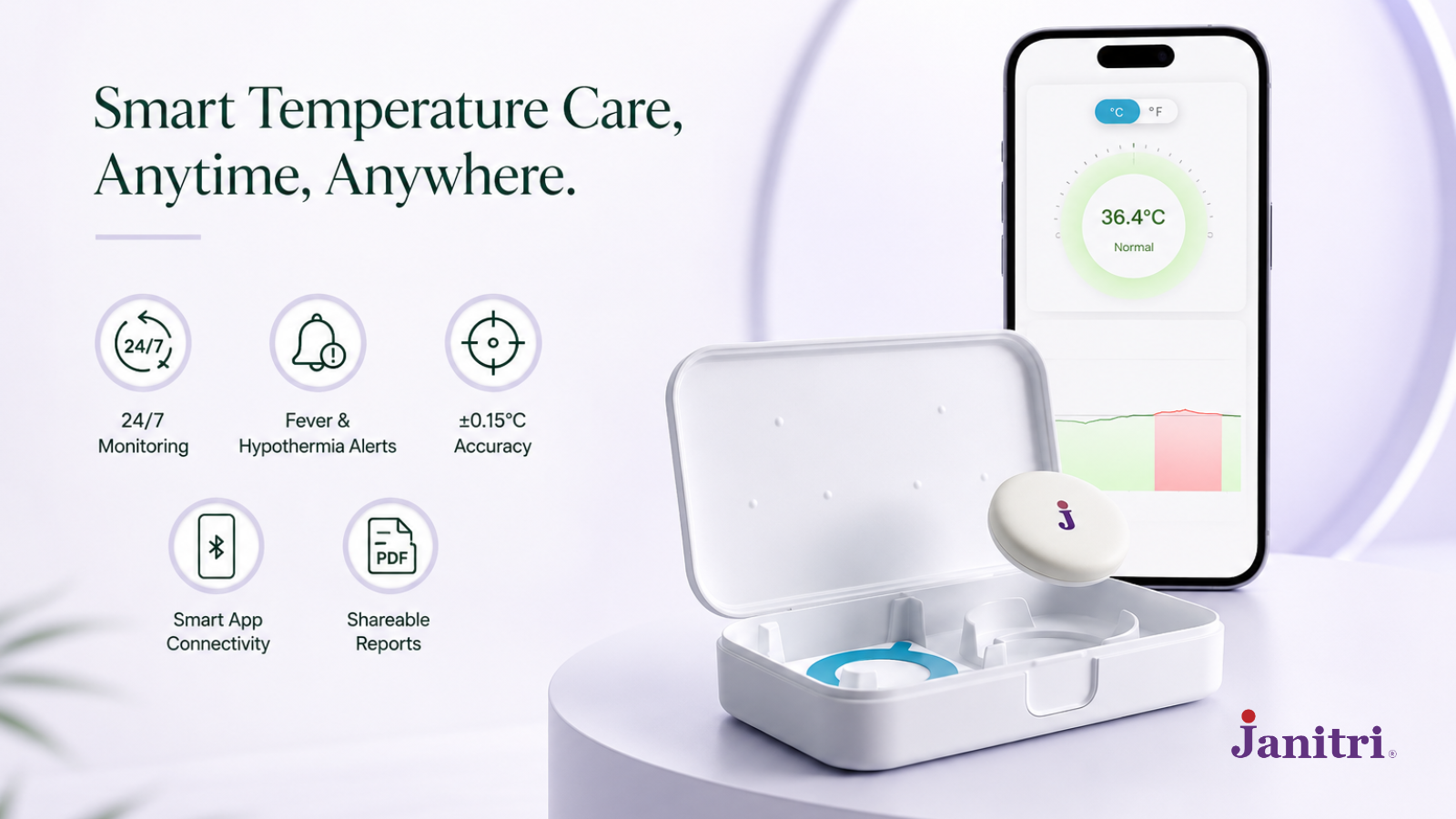
Instead of waking your baby repeatedly to take manual temperature readings, Navam TempLive offers a more convenient way to stay informed.
Why Parents Choose Navam TempLive
Continuous temperature monitoring for up to 24 hours
Real-time temperature updates directly on your smartphone
Instant fever alerts when your baby's temperature crosses the set threshold
Temperature history and trends to help you track recovery
Soft, lightweight, skin-friendly patch designed for babies
Whether it's after a vaccination, during a common viral illness, or while recovering at home, TempLive helps parents monitor their baby's temperature without disturbing their sleep.
Note: Navam TempLive is a monitoring device designed to support parents by providing continuous temperature updates. It is not a substitute for medical advice, diagnosis, or treatment. Always consult your pediatrician if your baby develops a high fever, persistent fever, or any concerning symptoms.
Conclusion
A mild fever after vaccination is usually a sign that your baby's immune system is building protection exactly as intended. In most cases, the fever starts within a day of vaccination and settles on its own within 48–72 hours. Keeping your baby comfortable, well-hydrated, and monitoring their temperature is often all that's needed.