Mothers
Wearable Continuous Temperature Monitor for Babies: A Smarter Way to Track Fever
Mar 3 • 10 min read
Table of Content
What Is a
Why Continuous Fever Monitoring Is Important for Babies (0–2 Years)
That's normal. Fever itself isn't the enemy.
Here's why continuous monitoring matters so much in these early years:
Signs of Fever in Babies Every Parent Should Know
Limitations of Traditional Thermometers for Infants
Benefits of Using a
How Real-Time Temperature Tracking Helps Reduce Fever Risks
Key Scenarios Where It Makes a Difference:
When to Worry About High Fever in Babies
Get medical help the same day if your baby:
Go to the emergency department or call an ambulance if your baby:
How to Choose the
A Product Worth Looking At
Templive: A Wearable Temperature Patch Designed for Babies
What This Means for Parents
Conclusion
A thermometer gives you a number. That number is useful — but it only reflects a single moment. What it doesn’t show is what’s happening before or after that reading. Is the temperature climbing steadily? Has it peaked? Is it starting to settle? For babies under two, those patterns often matter more than one isolated measurement.
In early childhood, fever can change quickly. Checking every hour or two provides accurate spot readings, but it leaves long gaps where temperature shifts may go unnoticed — especially overnight. That uncertainty can make it harder to judge whether things are improving or escalating.
This guide looks at what traditional and digital thermometers do well, where single-point checks have limitations during active fever episodes, and how continuous temperature monitoring can offer a clearer, more complete view — particularly during the first two years, when careful observation matters most.
What Is a Wearable Continuous Temperature Monitor for Babies?
Think of it like this: a regular thermometer is like taking a photograph. It captures one moment, perfectly still, and then it's done. A wearable continuous temperature monitor is more like a video it keeps watching, keeps recording, and keeps you informed the whole time.
In simple terms, it's a small, soft device that your baby wears, usually attached gently to their skin or clothing that tracks their body temperature around the clock. It connects to an app on your phone and quietly updates in the background. If the temperature goes too high, or rises too fast, it sends you an alert.
You don't have to wake up to check. You don't have to set hourly alarms. You just... know. In real time.
These devices are designed specifically with babies in mind lightweight, non-invasive, and safe for delicate skin. No poking, no prodding, no waking a finally-sleeping sick baby just to get a reading.
It's the difference between hoping nothing changes while you sleep and actually knowing.
Why Continuous Fever Monitoring Is Important for Babies (0–2 Years)
The first two years of a baby's life are, medically speaking, a particularly watchful time. Their immune system is brand new. It's still learning. And when it encounters a virus or infection for the first time, fever is one of its main tools for fighting back.
That's normal. Fever itself isn't the enemy.
But what makes this age group different from older children or adults is how fast things can change — and how little warning you sometimes get.
A baby can go from slightly warm to running a high fever in the space of a couple of hours. They can't tell you their head hurts or that they feel dizzy. They can't say "I feel worse than before." All they can do is cry, or go quiet, or seem a little off — signs that are easy to miss, especially at night.
Here's why continuous monitoring matters so much in these early years:
Babies under 3 months have very little immune reserve. A fever at this age is treated much more seriously than in older children — doctors want to know immediately.
Temperatures can change dramatically between your checks, especially overnight when you're asleep.
A slow, creeping fever that rises over several hours can be just as concerning as a sudden spike — and much harder to catch with occasional checks.
Parents and caregivers are sleep-deprived by default during this period. Continuous monitoring removes the dependency on human alertness to catch a problem.
The goal isn't to make you anxious. It's to make sure you have the information you need, when you need it — not hours after the fact.
Signs of Fever in Babies Every Parent Should Know
Before we talk about monitoring, it helps to know what fever actually looks like in a baby — because it's not always as obvious as a hot forehead.
The signs that often show up before you even reach for the thermometer:
Feeling warm or hot to the touch, especially on the forehead, tummy, or back
More fussy or irritable than usual — crying more, harder to settle, nothing seems to help
Going unusually quiet or limp — sometimes babies get very still or drowsy when unwell
Not feeding as well — refusing feeds or drinking less than normal
Looking flushed or pale, with cheeks that appear red
Sweating, particularly around the hairline or neck
Shivering or seeming cold, even when their skin feels hot — this can happen as the temperature is rising
Glazed or glassy-looking eyes
Signs that mean you should contact a doctor straight away
Any fever in a baby under 3 months old (38.0°C or above)
A temperature above 39.0°C in a baby between 3 and 6 months
A fever that lasts more than 5 days in any child under 2
A baby who seems very unwell, limp, or unusually unresponsive
A rash that appears alongside fever
Difficulty breathing or unusual noises when breathing
Signs of dehydration — no wet nappies for several hours, no tears when crying, dry mouth
Trust your instincts too. You know your baby. If something feels wrong, it's always okay to call your doctor even if you're not sure.
Limitations of Traditional Thermometers for Infants
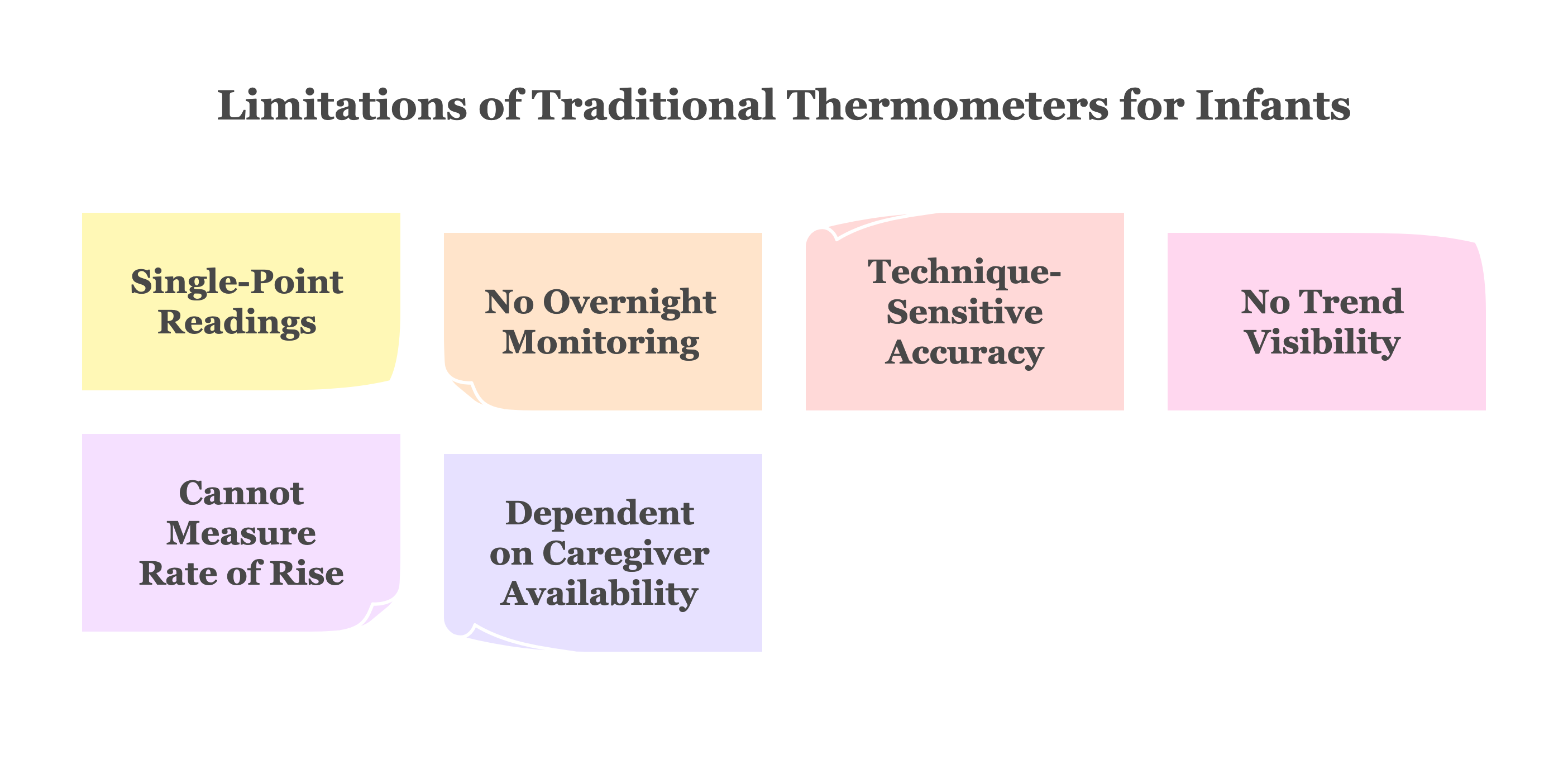
Traditional thermometers are useful and accurate for spot checks, but they have limitations when used for ongoing fever monitoring in babies.
Key Limitations:
Single-Point Readings Only
They show temperature only at the moment of use. Any spike between checks goes unnoticed.No Overnight Monitoring
Fever changes during sleep may not be detected until the next manual check.Technique-Sensitive Accuracy
Underarm, ear, and forehead readings can vary based on placement, movement, or recent activity.No Trend Visibility
A single reading doesn’t show whether temperature is rising, stable, or falling.Cannot Measure Rate of Rise
Rapid temperature increases cannot be identified with isolated measurements.Dependent on Caregiver Availability
Monitoring requires someone awake and actively checking at regular intervals.
Traditional thermometers remain valuable tools — but they are designed for periodic measurement, not continuous tracking.
Benefits of Using a Wearable Baby Temperature Monitor
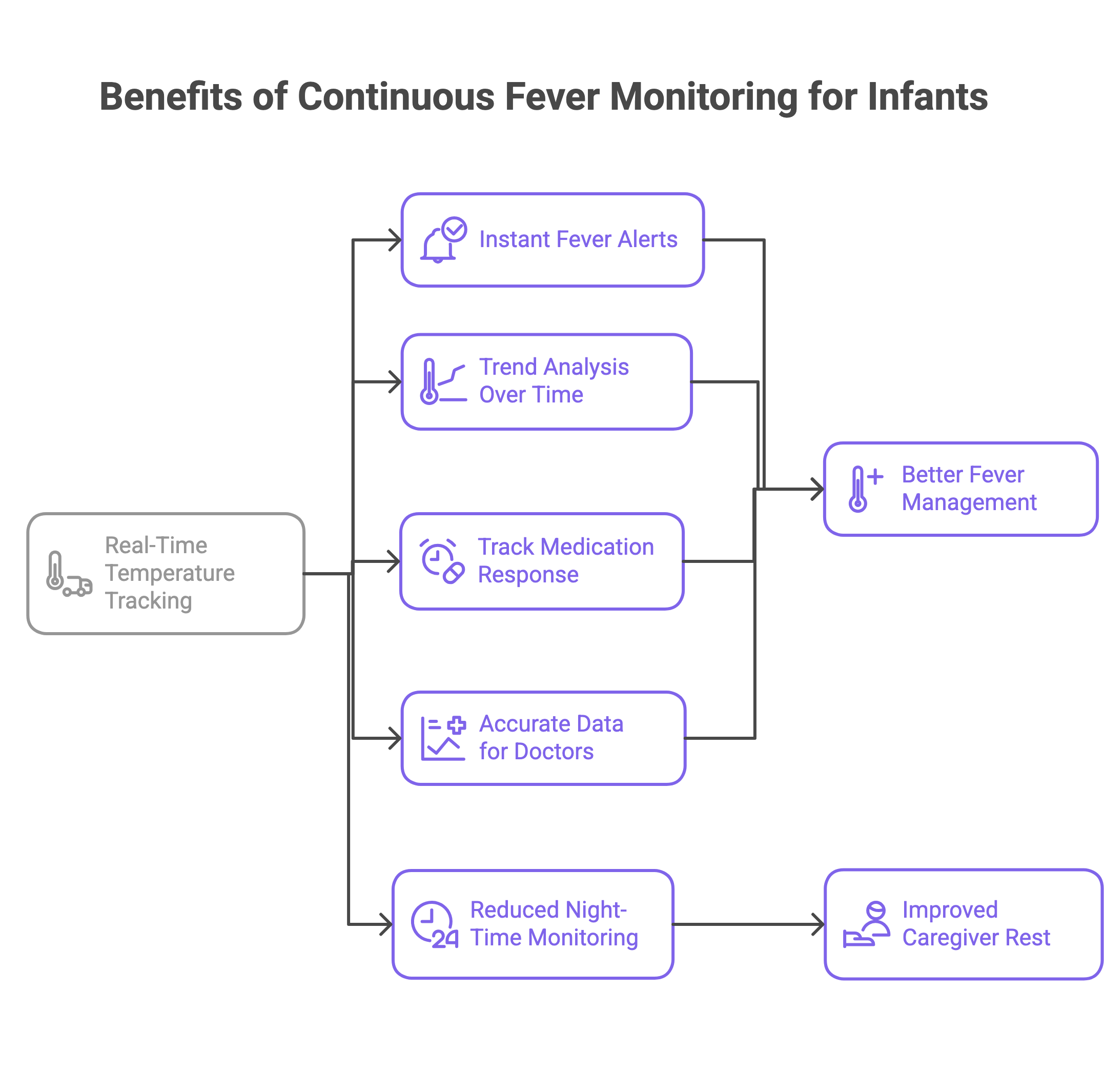
A wearable continuous baby temperature monitor offers more than occasional readings. It provides real-time temperature tracking, trend analysis, and smart alerts that help parents monitor fever more accurately. Instead of relying on manual checks, you receive continuous data that supports better decision-making during illness.
Key Benefits:
Real-Time Temperature Tracking
Monitor your baby’s body temperature continuously without repeated manual checks.Instant Fever Alerts
Get notified immediately when temperature crosses a preset threshold.Trend Analysis Over Time
View temperature graphs to understand whether fever is rising, stable, or decreasing.Track Medication Response
Observe how temperature changes after giving paracetamol or ibuprofen.Accurate Data for Doctors
Share timestamped temperature logs for clearer clinical discussions.Reduced Night-Time Monitoring
Avoid waking your baby frequently for temperature checks.Improved Caregiver Rest
Alerts allow parents to rest while still staying informed.Better Fever Management
Early detection of rapid changes supports timely action.
How Real-Time Temperature Tracking Helps Reduce Fever Risks
Real-time monitoring is not about panic — it’s about early awareness. Continuous tracking provides actionable data before a situation becomes urgent.
Key Scenarios Where It Makes a Difference:
Overnight Fever Spikes
Detects temperature increases while you’re asleep, allowing earlier intervention instead of discovering a high fever hours later.Rapid Temperature Rise
Identifies how quickly fever is increasing, helping you assess urgency and seek medical advice when needed.Informed Hospital Decisions
Trend data shows whether fever is responding to medication or continuing to rise, supporting clearer decisions.Avoiding Unnecessary ER Visits
Stable or decreasing temperature trends provide reassurance when monitoring at home is appropriate.
Continuous data supports timely action and more confident decision-making during fever episodes.
When to Worry About High Fever in Babies
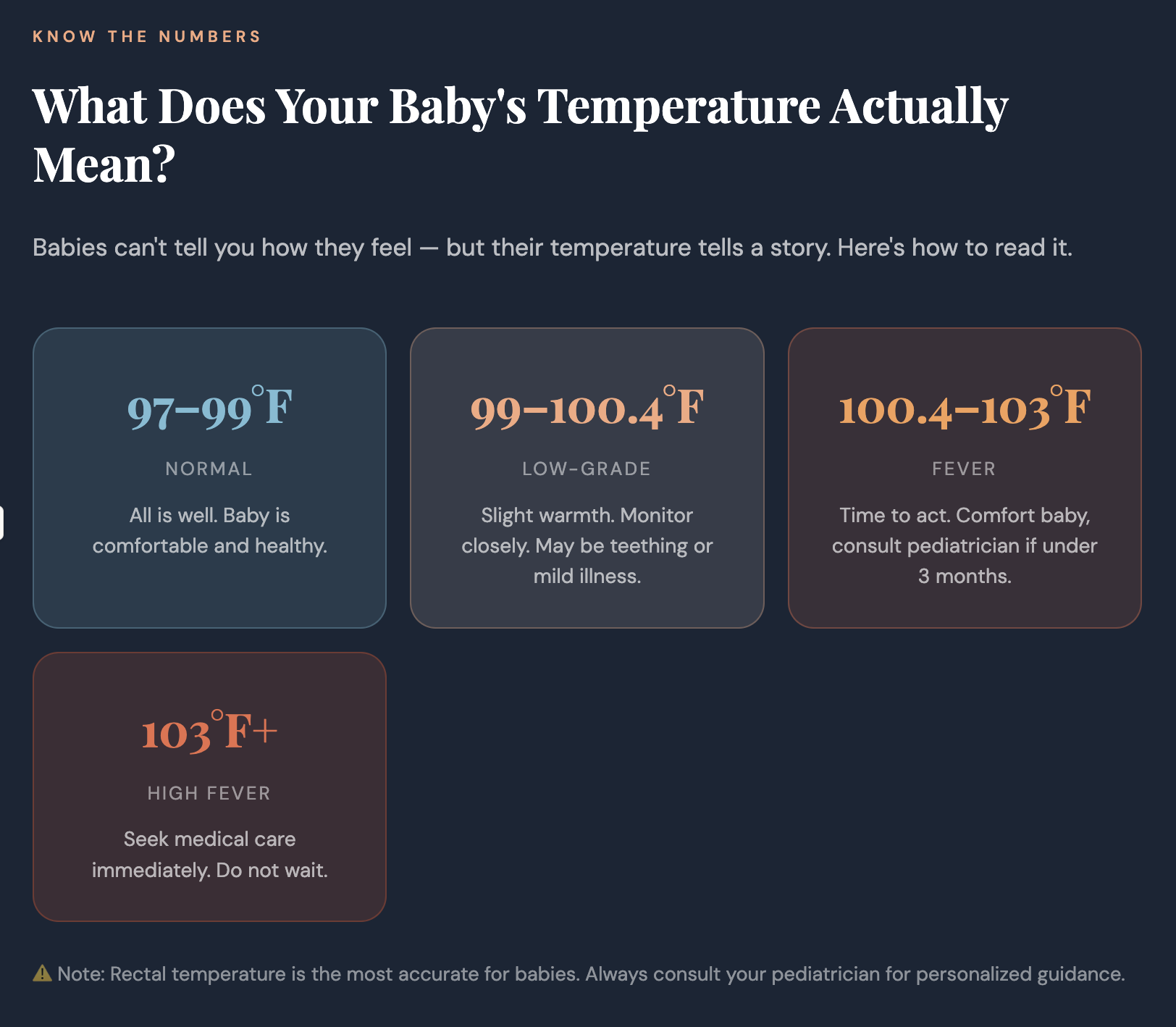
Most fevers in babies are caused by common viral infections and get better on their own within a few days. But there are times when a fever needs more than watchful waiting at home.
(Please note: the information below is general guidance only. Always contact your doctor if you're unsure.)
Get medical help the same day if your baby:
Is between 3 and 6 months old and has a temperature of 39.0°C or above
Has had a fever for more than 2–3 days without improving
Has other symptoms alongside the fever — ear pain, difficulty swallowing, rash
Go to the emergency department or call an ambulance if your baby:
Is under 3 months old with any fever of 38.0°C or above
Has a seizure (their body stiffens, shakes, or goes limp suddenly)
Has a rash that doesn't fade when you press a glass against it
Is having difficulty breathing — breathing very fast, noisy breathing, or working hard to breathe
Seems very unwell — unusually pale, limp, unresponsive, or very difficult to wake
Has not had a wet nappy in 8 hours or more (possible dehydration)
You're simply very worried, regardless of the temperature reading
Your instincts matter. You don't need to justify taking your baby to a doctor. If something feels wrong, go.
How to Choose the Best Temperature Monitor for Baby
If you've decided a wearable continuous temperature monitor makes sense for your family, here's what to look for — in plain, no-jargon terms:
1. Is it actually designed for babies? Some monitors are adapted from adult or older-child devices. Look for one built specifically for infants — the fit, materials, and accuracy standards should reflect that.
2. How accurate is it? This is non-negotiable. A monitor that reads 0.5°C off might not matter for an adult. For a baby, that margin can be the difference between "watch and wait" and "call the doctor now." Look for devices that have been clinically tested against proper medical thermometers.
3. What do the alerts actually do? Can you set your own temperature threshold? Does it notify you when the temperature is rising fast, not just when it reaches a number? Does the alert actually wake you up (a proper alarm notification, not just a soft ping)?
4. How does it attach — and will it stay on? Babies move. A lot. Look for a monitor that attaches securely but gently — not so tight it's uncomfortable, but not so loose it falls off every time your baby rolls over.
5. Is the app easy to use at 3am? You should be able to glance at your phone half-asleep and immediately understand what you're seeing. If the app requires hunting through menus and settings while exhausted, it's not doing its job.
6. Can you share the data with your doctor? A monitor that logs temperature history and lets you export or show the data to your healthcare provider is significantly more useful than one that only shows the current reading.
7. Is it easy to clean? Babies are messy. The device will need cleaning. Check that it's washable or wipeable and that doing so won't damage it.
A Product Worth Looking At
If you're looking for a wearable continuous temperature monitor designed specifically for babies, the product at the link below is worth exploring. It's built for non-invasive, real-time temperature tracking, with automatic alerts so parents can rest without worrying they'll miss something important.
Take a look here: Wearable Continuous Baby Temperature Monitor
This is shared as a helpful pointer, not a sales pitch. As with anything health-related for your little one, we'd encourage you to read through the details and have a chat with your doctor about whether it's a good fit for your family.
Templive: A Wearable Temperature Patch Designed for Babies
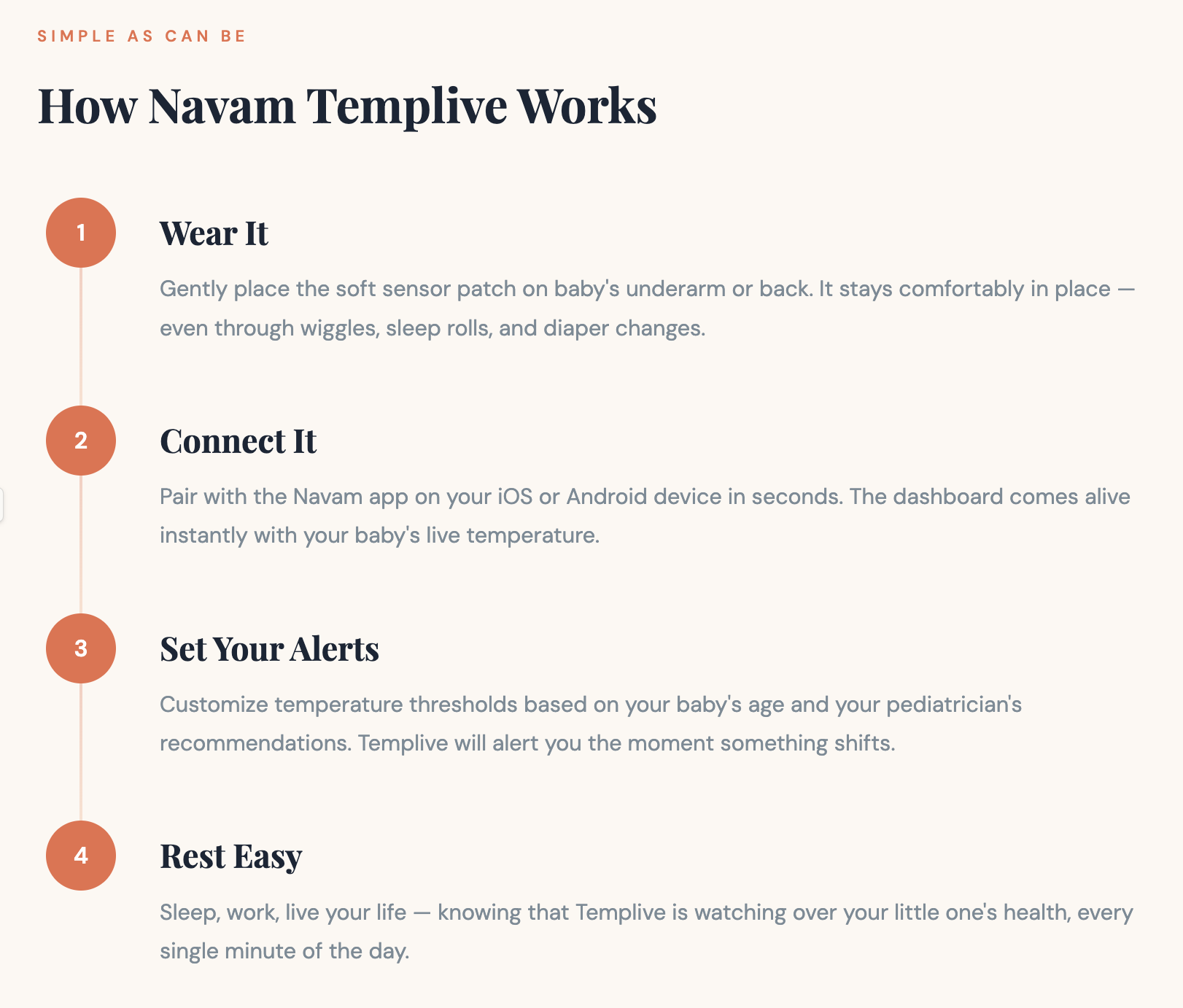
Templive is a soft, wearable temperature monitoring patch created specifically for babies and young children. Developed by a team experienced in maternal and neonatal monitoring, it brings hospital-style continuous temperature tracking into a home setting — in a baby-friendly format.
What This Means for Parents
Continuous Temperature Trends
View real-time temperature patterns instead of isolated readings. See whether fever is rising, stabilising, or responding to medication.Smart Alerts
Receive instant notifications if temperature crosses a preset threshold, helping you respond early.Undisturbed Sleep for Baby
No repeated midnight checks. The patch monitors quietly while your baby rests.Minute-by-Minute Tracking
Detect rapid temperature increases that may require closer observation or medical consultation.Accurate Data for Pediatric Visits
Share timestamped temperature logs with your doctor for clearer assessment and better-informed decisions.
Templive is designed to support parents with consistent, reliable data — helping improve fever monitoring during the critical first years of life.
Conclusion
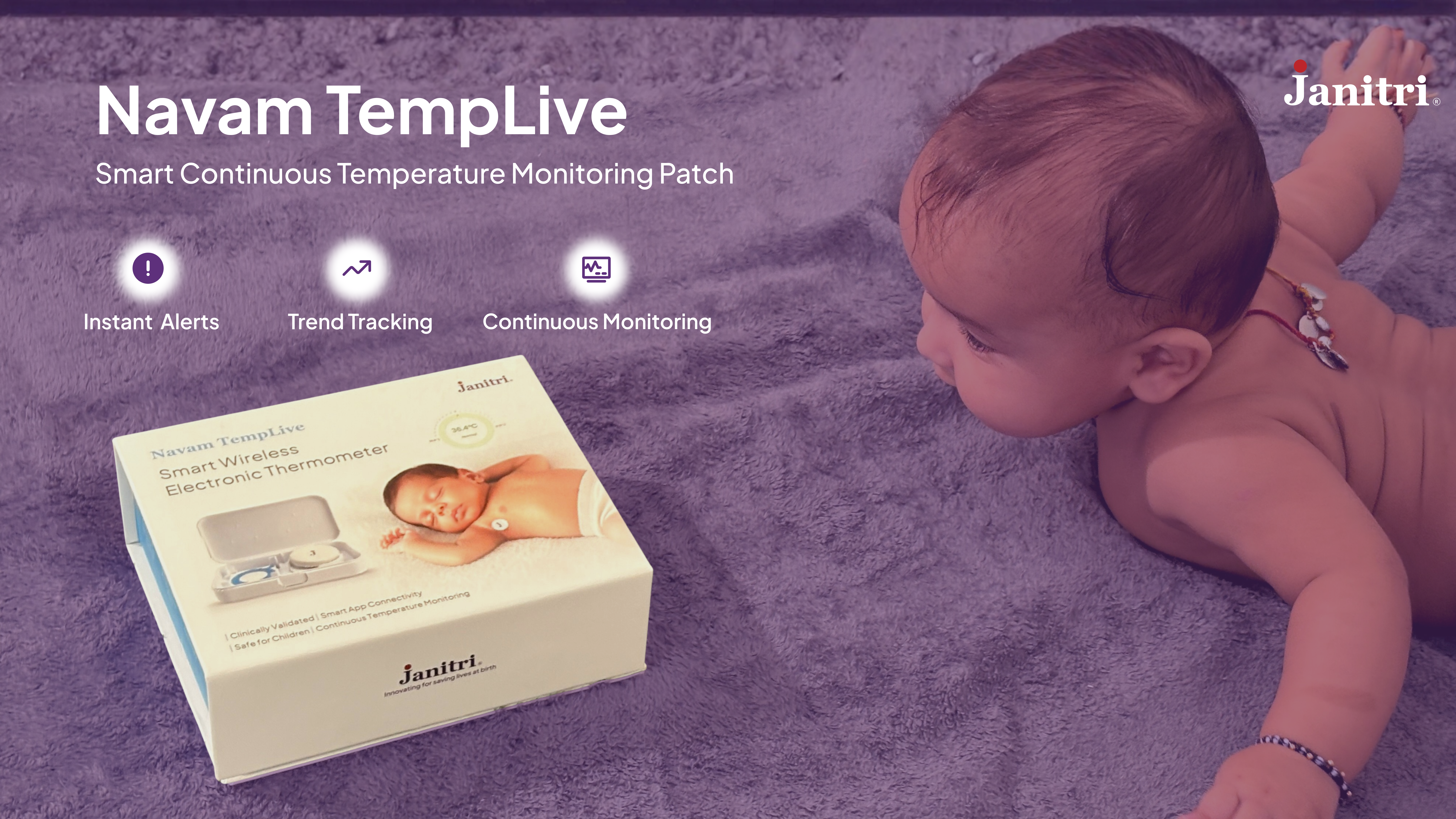
A regular thermometer is an important tool — but it provides only periodic readings.
During the first two years of life, a baby’s immune system is still developing, and fever patterns can change quickly. Relying solely on occasional checks may leave gaps in information, particularly overnight.
A wearable continuous temperature monitor supports parents by tracking temperature in real time and sending alerts when needed. It doesn’t replace parental judgment — it adds consistent data so you can respond promptly while still getting necessary rest.
Timely alerts combined with adequate caregiver rest can improve clarity, decision-making, and overall fever management.