Mothers
Best Baby Thermometer: Accurate Fever Detection Guide
Mar 10 • 18 min read
Table of Content
What Is Considered a Fever in a Baby? (The Numbers Parents Must Know)
Types of Baby Thermometers: A Clinical Breakdown
Rectal Thermometers
Temporal Artery (Forehead) Thermometers
Tympanic (Ear) Thermometers
Axillary (Underarm) Thermometers
Pacifier Thermometers
Continuous Temperature Monitors (Wearable Patches)
How to Check Baby Temperature Correctly: Step-by-Step
Most Accurate Thermometer for Babies: What Clinical Evidence Says
Wearable and Continuous Temperature Monitoring for Babies
Why Single-Point Checks Have Gaps
What Is a Wearable Baby Temperature Monitor?
How Accurate Are Wearable Temperature Monitors?
Who Needs Continuous Temperature Monitoring?
Safe Thermometer for Babies: What to Look for Beyond Accuracy
Baby Temperature Monitoring at Home: Building a System That Works
Common Mistakes Parents Make When Taking Baby Temperature
Choosing the
Frequently Asked Questions (FAQ)
When your baby feels warm, panic sets in fast. You reach for whatever thermometer is nearby, get a reading, and then wonder: Is this number actually right? Choosing the best baby thermometer is not just about convenience. It is about getting an accurate number at the moment it matters most, because in infants, even a half-degree error can change what a doctor recommends.
This guide is built on clinical evidence, AAP guidelines, and peer-reviewed research. It covers every thermometer type, how to use each one correctly, what accuracy benchmarks actually mean, and how newer continuous temperature monitoring for babies technology is changing baby fever monitoring at home. By the end, you will know exactly what to buy, when to use it, and when to call a doctor.
The best thermometer for babies under 3 months is a rectal digital thermometer. For babies 3 months and older, a validated temporal artery (forehead) thermometer is accurate and non-invasive. Wearable monitors add continuous overnight tracking but do not replace spot readings for clinical decisions. A fever of 38°C (100.4°F) or above in any baby under 3 months is a medical emergency.
What Is Considered a Fever in a Baby? (The Numbers Parents Must Know)
Before choosing a thermometer, understand what you are measuring for.
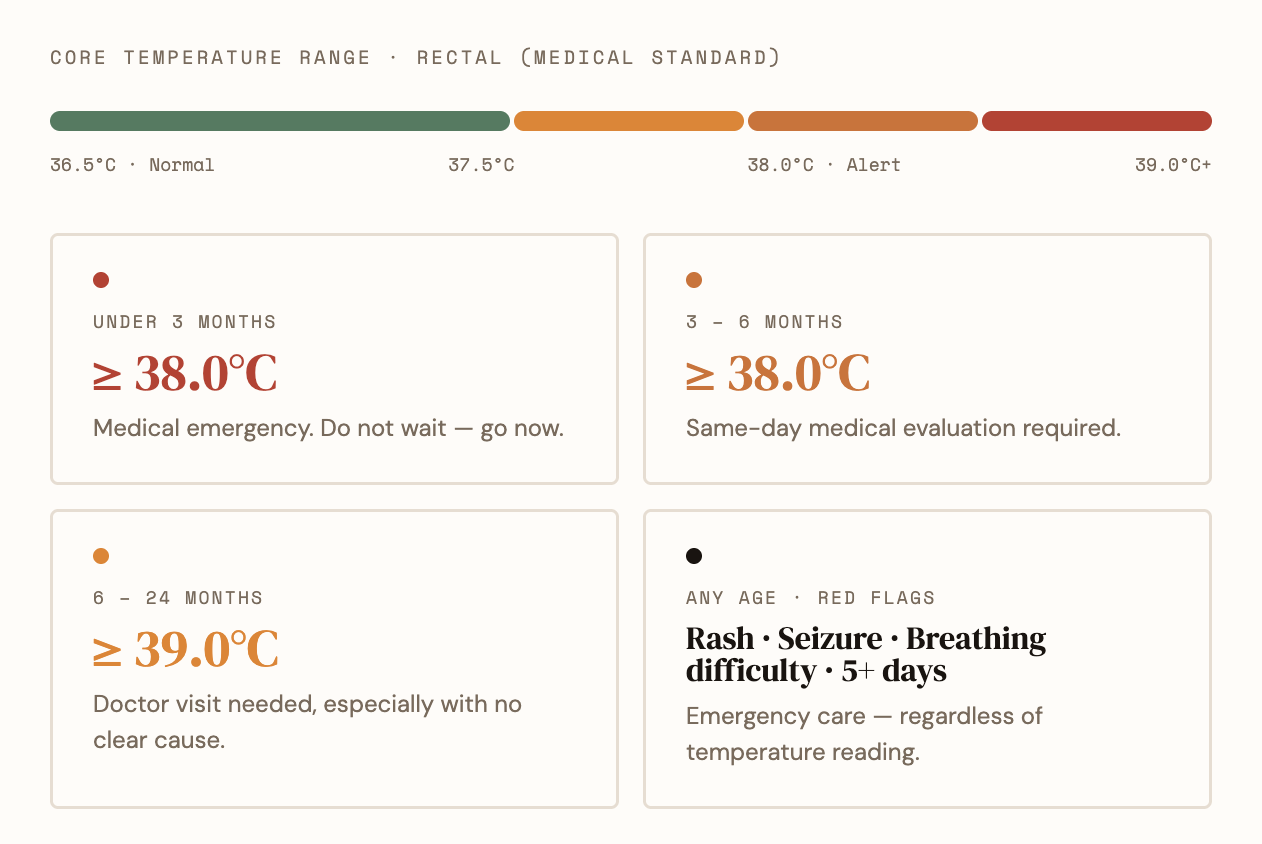
Normal body temperature in a newborn ranges from 36.5°C to 37.5°C (97.7°F to 99.5°F), depending on the measurement site. The thresholds that require action are:
Under 3 months: Any rectal temperature at or above 38.0°C (100.4°F) is a medical emergency. Do not wait.
3 to 6 months: Temperature at or above 38.0°C warrants same-day medical evaluation.
6 to 24 months: Temperature at or above 39.0°C (102.2°F), especially with no obvious cause, needs a doctor visit.
Any age: A fever lasting more than five days, or accompanied by rash, difficulty breathing, seizure, or unusual unresponsiveness, requires emergency care.
These thresholds come directly from the American Academy of Pediatrics (AAP) fever management guidelines. Knowing them determines how precise your thermometer needs to be. In a newborn, a device that reads 0.5°C below true temperature could cause a parent to miss a critical threshold entirely.
Body temperature is not uniform. Core temperature (measured rectally) is the medical standard. Forehead, ear, and underarm readings approximate this differently and with varying accuracy margins. The AAP states that rectal measurement remains the most accurate method for infants, and that other methods should be understood as approximations.
Types of Baby Thermometers: A Clinical Breakdown
Type | Accuracy | Best Age | Speed | Recommendation |
|---|---|---|---|---|
Rectal | ***** | 0–3 months | Slow | Best accuracy |
Forehead | **** | 3+ months | Fast | Easy use |
Ear | *** | 6+ months | Fast | Medium accuracy |
Wearable | *** | All | Continuous | Monitoring |
Rectal Thermometers
Rectal measurement gives true core body temperature. It is the gold standard for infants under 3 months, and the method against which all other thermometer types are validated in clinical studies.
Rectal measurement consistently produces the most accurate core temperature readings across all age groups, as confirmed in multiple comparative studies. Forehead and ear devices show acceptable, but wider, error margins when tested against this baseline.
How to use it safely:
Use a flexible-tip digital thermometer for babies designated only for rectal use. Never use the same device orally.
Lubricate the tip with a small amount of petroleum jelly.
With your baby lying on their back, gently insert the probe no more than 1.3 cm (half an inch) into the rectum.
Hold firmly but gently until the beep sounds. Most readings complete in under 10 seconds.
Normal rectal range: 36.6°C to 38.0°C (97.9°F to 100.4°F)
What to buy: Choose a model with a flexible tip, insertion depth marker, and audible completion alert. The Fridababy FridaMom and FridaBaby rectal thermometers are widely recommended by US pediatricians. The Safety 1st Gentle Read is another consistently accurate option.
Temporal Artery (Forehead) Thermometers
Temporal thermometers use infrared sensors to measure heat radiating from the superficial temporal artery, which runs across the forehead. They are non-invasive, fast (under 3 seconds), and do not disturb a sleeping baby.
A landmark systematic review by Craig et al. published in The Lancet (PMID: 12241931) compared infrared thermometry with rectal thermometry across paediatric age groups. It found that temporal artery thermometers showed clinically acceptable accuracy for children over 3 months in outpatient settings, but demonstrated wider variability in infants under 3 months and should not replace rectal thermometry in neonates.
Accuracy limitations to know:
Sweating, hair covering the forehead, or recent physical activity all reduce accuracy.
Lateral positioning or incorrect scanning technique can produce readings up to 0.5°C lower than true temperature.
Always scan from the hairline to just behind the ear in one fluid motion, as instructed.
What to buy: The Exergen TAT-2000C and Braun No Touch Forehead are among the most validated models for paediatric use. The Exergen device has been studied in clinical settings and is used in many US paediatric hospitals.
Tympanic (Ear) Thermometers
Tympanic thermometers measure infrared radiation from the tympanic membrane (eardrum), which shares a blood supply with the hypothalamus, the brain's temperature control centre. In theory, this makes them highly relevant for core temperature.
In practice, accuracy in babies under 6 months is poor. The ear canal in newborns and young infants is too narrow and curved to allow proper probe alignment. Earwax buildup and ear infections further compromise readings. A misaligned probe can produce results 1°C below true temperature.
Use tympanic thermometers from 6 months onward. Always pull the ear gently backward to straighten the canal, and use the same ear each time for consistency.
What to buy: Braun ThermoScan 7 IRT6520 is the most widely clinically validated ear thermometer for children. Its Age Precision feature adjusts the normal temperature range displayed by age group, which is genuinely useful for parents managing multiple children.
Axillary (Underarm) Thermometers
Underarm measurement is the least invasive and least accurate method. It consistently reads 0.5°C to 1.0°C below core temperature because skin surface temperature is affected by ambient air, clothing, and sweat.
The AAP acknowledges underarm temperature as a screening tool only. If an underarm reading shows 37.2°C (99°F) or above in an infant, follow up immediately with a rectal reading for confirmation. Never use underarm alone to rule out fever in a baby under 3 months.
Pacifier Thermometers
Pacifier thermometers measure oral temperature passively while a baby sucks. The concept is appealing but clinically unreliable. Babies do not keep a pacifier still long enough for consistent measurement, and studies have found unacceptable accuracy variability. The AAP does not recommend them for clinical fever detection in infants.
Continuous Temperature Monitors (Wearable Patches)
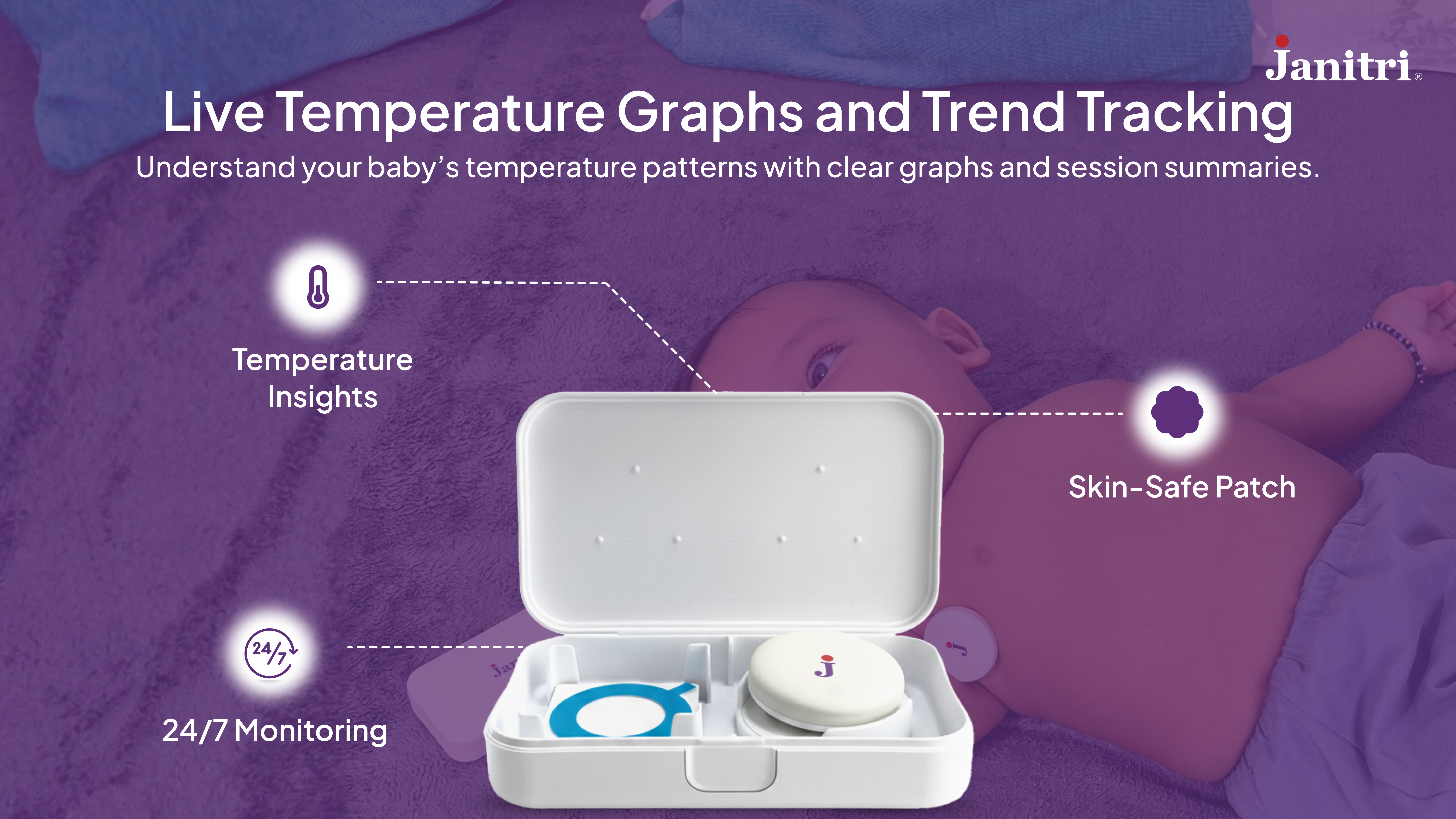
Continuous temperature monitors are a newer and distinct category that works very differently from every thermometer type above. Rather than giving you a single reading at a single moment, a continuous temperature monitoring for babies device attaches to your baby's skin as a soft, lightweight patch and transmits temperature data to your smartphone every 30 to 60 seconds, around the clock.
This makes continuous monitors the only type that can show you a complete temperature trend: whether fever is rising, plateauing, or responding to medication. They alert you the moment temperature crosses a threshold you set, even while you and your baby are asleep.
How they differ from spot thermometers:
Spot thermometers (rectal, forehead, ear) measure temperature at one moment. You get a number and then nothing until you check again.
A continuous monitor gives you a live graph of temperature over time, so you see the full picture of a fever episode rather than disconnected snapshots.
Key use cases where they add the most value:
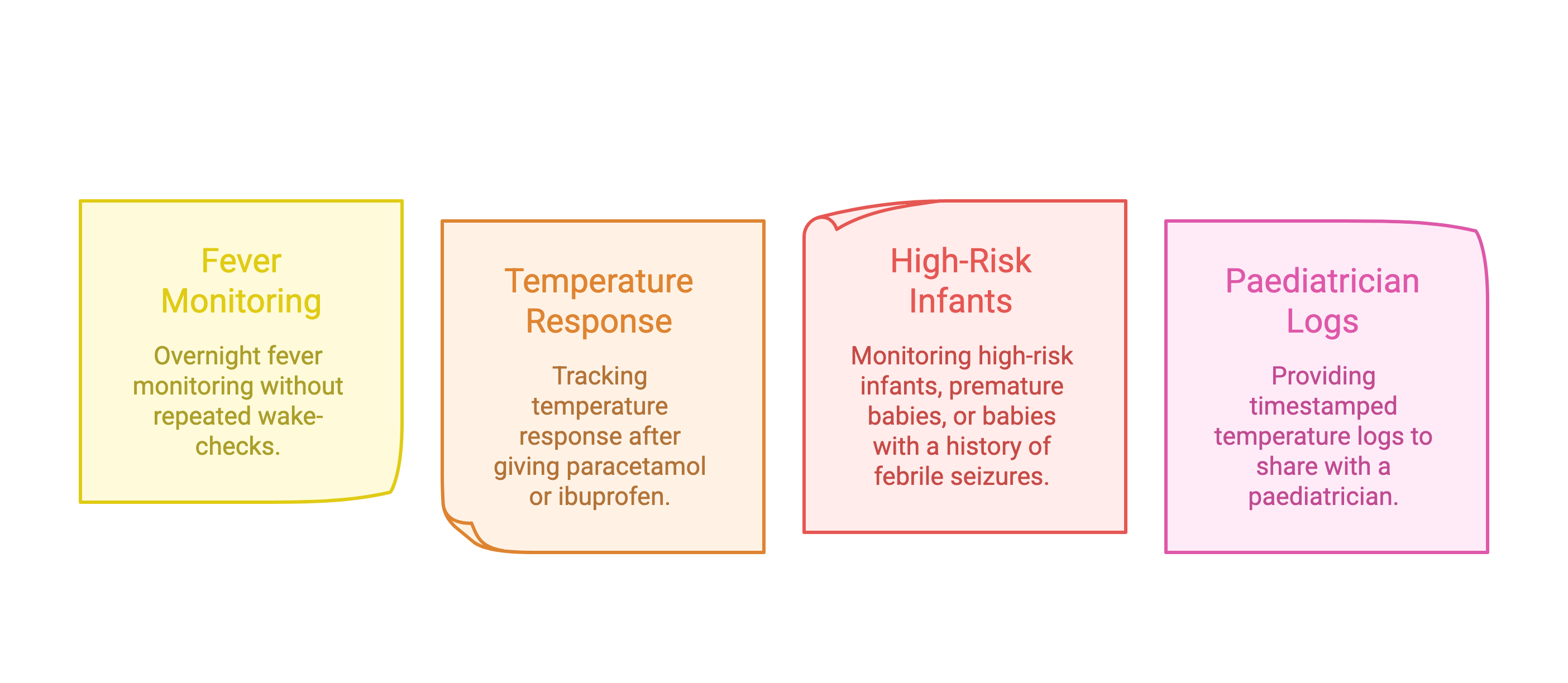
Overnight fever monitoring without repeated wake-checks
Tracking temperature response after giving paracetamol or ibuprofen
Monitoring high-risk infants, premature babies, or babies with a history of febrile seizures
Providing timestamped temperature logs to share with a paediatrician
Important limitation: Continuous monitors use axillary (underarm) or chest-surface placement, which means they approximate core temperature rather than measuring it directly. They are an early warning and trend tool. When an alert fires, always confirm with a rectal or validated forehead thermometer before making a clinical decision.
What to look for: Baby-specific design with hypoallergenic adhesive, alert customisation, Bluetooth or Wi-Fi app connectivity, and a temperature history log. One option developed specifically for the Indian market is Navam Templive by Janitri, a neonatal monitoring technology company. It is built for infant skin, integrates with the Janitri app, and provides minute-by-minute tracking with smart alerts.
How to Check Baby Temperature Correctly: Step-by-Step
Knowing how to check baby temperature accurately is as important as owning the right device. Technique accounts for a significant portion of thermometer error in home settings.
Rectal (recommended under 3 months):
Wash hands. Gather the thermometer, petroleum jelly, and a clean nappy.
Lay your baby on their back on a firm, flat surface.
Apply a small amount of petroleum jelly to the thermometer tip.
Gently hold your baby's ankles and lift their bottom slightly.
Insert the probe no more than 1.3 cm (half an inch) into the rectum.
Hold gently in place until the device beeps. Do not let go.
Remove carefully, note the reading, and wipe the tip with alcohol before storing.
Forehead (3 months and older):
Make sure the forehead is dry. Wipe away sweat or moisture if present.
Position the probe at the centre of the forehead at the hairline.
Glide it steadily across to just behind the ear in one motion.
Read the result. If in doubt, repeat once and take the higher reading.
Ear (6 months and older):
Gently pull the outer ear straight back (not up) to open the canal.
Insert the probe snugly in the ear canal direction, not straight in.
Press and hold until the beep sounds.
Always use the same ear for repeat measurements during an illness.
Underarm (screening only, all ages):
Place the thermometer tip in the centre of the dry armpit.
Hold the arm flat against the body for the full measurement duration.
Add 0.5°C to the result if estimating core temperature. Then confirm rectally if the adjusted reading approaches 38°C.
Most Accurate Thermometer for Babies: What Clinical Evidence Says
When evaluating the most accurate thermometer for babies, the benchmark in every published study is rectal temperature. All other methods are assessed on how closely they correlate with this baseline.
Research consistently shows the same pattern across studies. Rectal thermometers produce the narrowest error margins across all age groups. Temporal artery thermometers show mean absolute errors of 0.2°C to 0.5°C in children over 3 months. Tympanic thermometers have acceptable accuracy from 6 months but high variability in younger infants. Axillary thermometers consistently underestimate core temperature by a clinically meaningful margin. This is supported by the AAP's fever guidelines (Sullivan & Farrar, Pediatrics, 2011, PMID: 21357332), which form the clinical foundation for how all thermometer accuracy standards are evaluated in paediatric practice.
What this means for buying decisions:
For a newborn, invest in a quality rectal digital thermometer as your primary device. As your baby grows past 3 months, a validated temporal thermometer becomes practical for quick, low-disturbance checks. You do not need to spend the most money, but you do need to choose devices that have been clinically tested in paediatric populations, not just adults.
Key buying criteria:
Clinical validation in children (check the product's research page or FDA clearance status)
Measurement time under 10 seconds for spot thermometers
Memory recall of at least 10 readings for trend tracking
Backlit display for night checks
Mode selection (rectal, oral, axillary) so one device serves multiple uses
BPA-free, phthalate-free materials for anything touching a baby's skin
Wearable and Continuous Temperature Monitoring for Babies
Traditional thermometers give you a single data point. Wearable technology gives you a continuous data stream. The difference matters most during active fever episodes, especially overnight.
Why Single-Point Checks Have Gaps
A baby's temperature can rise significantly within 60 to 90 minutes. If you check at 11 pm and find 37.8°C, then sleep until 2 am without checking, a fever that peaked at 39.5°C at 1 am would be invisible to you. You would have no data, no alert, and no way to know whether your baby needed attention.
This is not a hypothetical risk. Fever in infants under two years tends to escalate quickly, particularly overnight when the body's natural temperature regulation follows circadian patterns that push core temperature higher in the early hours of the morning.
What Is a Wearable Baby Temperature Monitor?
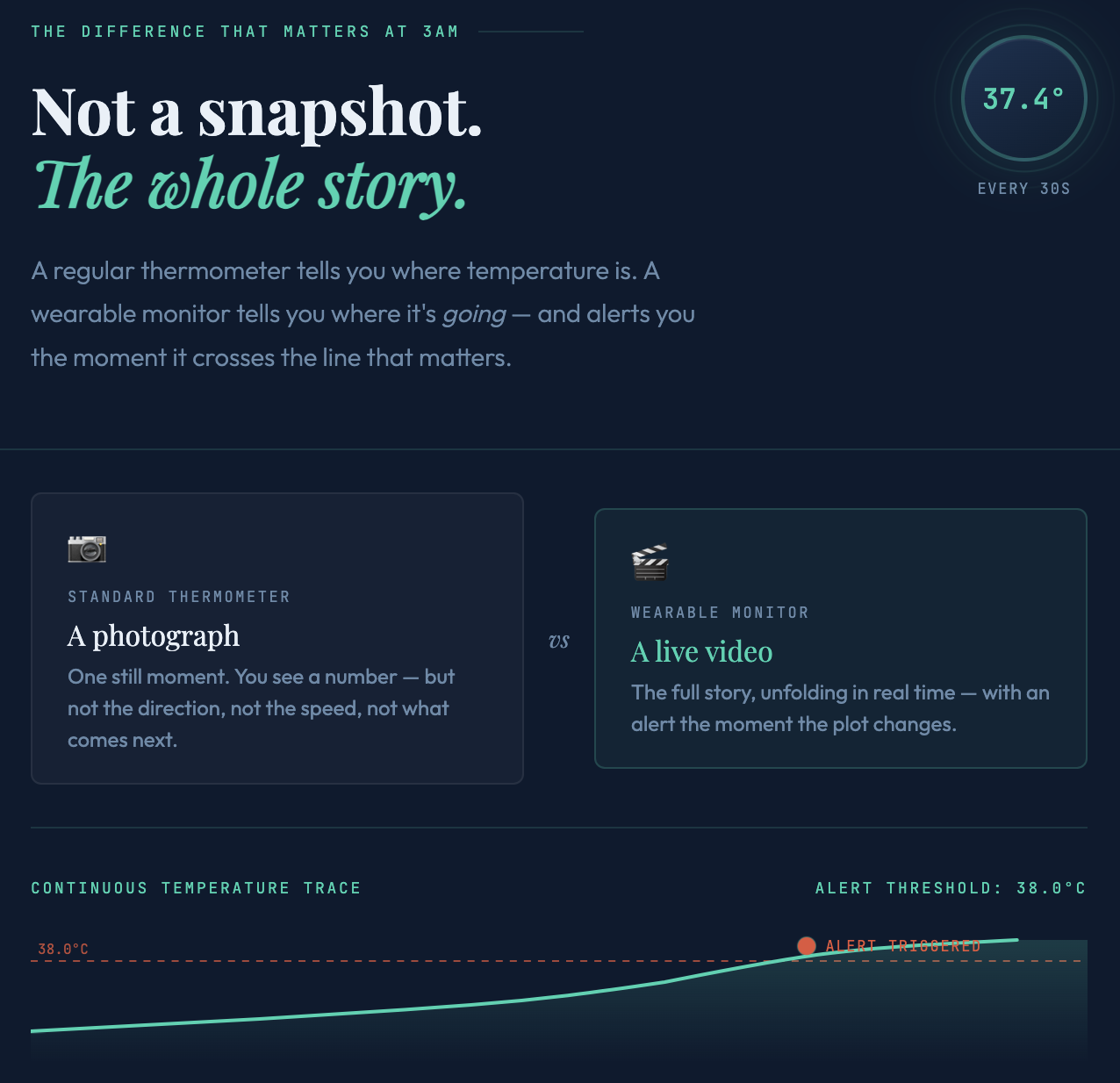
A wearable baby temperature monitor is a small, soft patch or sensor that attaches gently to your baby's skin and transmits temperature data to a smartphone app continuously, typically every 30 seconds to one minute. You set a threshold, and if temperature crosses it, you receive an immediate alert.
A useful way to understand the difference: a regular thermometer is like taking a photograph. It captures one still moment and then it is done. A continuous monitor is like a video. It keeps recording the full story so you see not just the number, but the direction and speed of change. This distinction is explained clearly in Janitri's guide to wearable continuous baby temperature monitors, which covers the clinical gaps that spot thermometers cannot address in active fever situations.
Continuous monitoring is particularly valuable for:
Infants under 3 months with any sign of illness, where temperature escalation is a medical emergency
Babies with a history of febrile seizures, where catching rapid temperature rise early can prevent recurrence
Overnight monitoring without waking the baby repeatedly
Tracking how temperature responds after giving paracetamol or ibuprofen (if temperature does not drop within 30 to 45 minutes, that matters clinically)
Single parents or caregivers managing illness alone overnight, who cannot sustain hourly manual checks
How Accurate Are Wearable Temperature Monitors?
A systematic review by Jefferies et al. (PMID: 21261573) evaluated the accuracy of peripheral temperature measurement methods in estimating core body temperature and found that non-core sensors, including axillary and surface-mounted devices, showed acceptable accuracy for trend monitoring but meaningful variability for precise clinical threshold decisions. Accuracy was significantly affected by sensor displacement, skin moisture, and ambient temperature.
The clinical takeaway: wearable monitors are reliable for trend detection and threshold alerts. They are not substitutes for a spot rectal reading during acute illness in neonates. Use them as a continuous early warning layer, then confirm any alert with a validated spot thermometer.
Who Needs Continuous Temperature Monitoring?
Continuous temperature monitoring for babies is not necessary for every household. It adds the most value when:
Your baby has had a febrile seizure (rapid temperature rise is the known trigger; continuous monitoring gives the earliest possible alert)
Your baby is under 3 months and has any ongoing illness or has recently had a procedure
You are managing a medically complex infant at home following hospital discharge
You have no co-parent or caregiver support during the night
Your baby has had repeated overnight fever spikes during a current illness episode
For otherwise healthy babies in households with attentive, well-rested caregivers, a quality rectal thermometer plus a forehead device for quick checks is generally sufficient.
Safe Thermometer for Babies: What to Look for Beyond Accuracy
A safe thermometer for babies needs to perform accurately under the conditions of real parenting: a squirming infant, bad lighting, sleep deprivation, and genuine fear.
Physical safety features:
Flexible probe tip on rectal and oral models. A rigid probe can cause injury if a baby moves suddenly during measurement.
Insertion depth marking on rectal thermometers. This prevents over-insertion.
Rounded, smooth casing with no sharp edges or small detachable parts.
BPA-free and phthalate-free materials throughout, confirmed on the product label.
Usability under stress:
Large, backlit display readable in a dark room at arm's length.
Audible completion beep plus vibration alert. Silent models require you to watch the screen throughout.
Memory recall for at least 10 readings. You will want to show your doctor the last several readings, not just the current one.
Fast measurement time. A 60-second wait with a screaming baby produces inaccurate readings because distress raises temperature. Under 10 seconds is the practical standard.
Materials and maintenance:
Waterproof or water-resistant casing for cleaning with an alcohol wipe between uses.
Dishwasher-safe probe covers if the model uses them.
Replaceable batteries, not rechargeable-only. Rechargeables go flat at 2 am.
Avoid glass mercury thermometers entirely. The AAP banned their recommendation in 2000 due to mercury toxicity risk from breakage. If you have one, dispose of it through a pharmaceutical or hazardous waste collection point.
Baby Temperature Monitoring at Home: Building a System That Works
Baby fever monitoring at home works best when it is systematic rather than reactive. Panic-checking with whichever device is closest produces inconsistent data and increases parental anxiety without improving outcomes.
Build a two-device system from day one.
Keep a rectal digital thermometer as your primary, definitive measurement tool. Add a forehead thermometer or a wearable continuous monitor as your quick-check and overnight monitoring layer. These two tools serve different functions and are more useful together than either is alone.
Log every reading.
Time, temperature, measurement method, and any medication given. Your paediatrician needs a trend, not a single number. Many thermometer apps (including Kinsa's companion app) log this automatically. If your thermometer does not have an app, a simple notes app on your phone works. A single reading without context tells a doctor very little. Five readings over eight hours with timestamps tells them a great deal.
Know your call thresholds before illness starts.
Write these down and keep them visible:
Any rectal temperature at or above 38°C (100.4°F) in a baby under 3 months: call immediately, do not wait.
Rectal temperature above 39°C in a baby 3 to 6 months: call your doctor same day.
Any fever in any infant under 1 month: go to emergency care directly.
Fever lasting more than 48 hours in any baby under 2 years: speak to your doctor.
Fever accompanied by rash, seizure, difficulty breathing, or unusual limpness: emergency care immediately.
Track medication response with timestamps.
If you give paracetamol or ibuprofen, note the time and continue taking readings every 30 minutes for two hours. Temperature should begin dropping within 30 to 60 minutes of an effective dose. If it does not, or if it drops and then spikes higher than before, that information is critical for your doctor.
Use a wearable for overnight illness episodes.
A smart baby thermometer worn continuously removes the need for repeated wake-checks that disturb both baby and parent. Set the alert threshold at 38.5°C for babies over 3 months. For babies under 3 months, any continuous monitoring is supplementary to keeping them in the same room and checking frequently, as the risk window is too narrow to rely on technology alone.
Common Mistakes Parents Make When Taking Baby Temperature
Using the wrong thermometer for the age. Ear thermometers used on infants under 6 months produce unreliable readings. Underarm readings used as a definitive result in newborns can miss critical fever thresholds. Match the method to the age.
Not waiting after activity. Crying, feeding, or physical activity raises skin and body temperature temporarily. Wait 15 minutes after your baby settles before taking a reading if the situation allows.
Reading a temporal thermometer incorrectly. Scanning too quickly, not reaching behind the ear, or scanning over hair rather than skin are the three most common errors. Always scan on bare skin from hairline to just behind the ear.
Trusting a cold forehead to rule out fever. A baby can have a significant internal fever with cool-feeling skin, especially early in a fever when vasoconstriction is occurring. Always use a thermometer, not touch, for clinical decisions.
Comparing readings across methods without adjustment. A 37.5°C underarm reading does not mean the same as a 37.5°C rectal reading. Add approximately 0.5°C to an underarm reading to estimate core temperature. For ear readings, the adjustment varies by device.
Choosing the Best Baby Thermometer: What to Do Right Now
The best baby thermometer is not a single product. It is a combination of the right tool, used correctly, at the right moment in your baby's development.
For newborns: buy a clinically validated rectal digital thermometer before your baby is born. Not after. You do not want to be ordering one during your baby's first fever at 3 am.
For babies 3 months and older: add a temporal artery (forehead) thermometer from a validated brand for fast, non-invasive daily checks. Use the rectal thermometer to confirm any reading that approaches a call-doctor threshold.
For parents who need overnight monitoring, have a medically complex infant, or have dealt with febrile seizures: consider a wearable baby temperature monitor for continuous tracking. Navam Templive is a clinically informed option developed by Janitri for the Indian market. Research it, speak to your paediatrician, and decide based on your baby's specific situation.
Whatever devices you choose, set up your monitoring system before illness arrives. Know your thresholds. Log your readings. And trust your instincts. A thermometer tells you a number. You, knowing your baby, provide the context that makes that number meaningful.
Invest in the right baby fever thermometer today. It is one of the most important pieces of kit in your home for the first two years of your child's life.
Frequently Asked Questions (FAQ)
What is the most accurate thermometer for babies?
Rectal digital thermometers are considered the most accurate method for measuring a baby’s core body temperature, especially for infants under 3 months.
What temperature is considered a fever in babies?
A rectal temperature of 38°C (100.4°F) or higher is considered a fever in babies and requires medical attention, especially for infants under 3 months.
Are forehead thermometers accurate for babies?
Temporal artery forehead thermometers are accurate for babies older than 3 months when used correctly, but rectal thermometers remain the gold standard for newborns.
What is a wearable baby temperature monitor?
A wearable baby temperature monitor is a soft sensor patch that continuously tracks a baby’s temperature and sends real-time alerts to a smartphone app.
How often should parents check a baby's temperature during fever?
During a fever episode, parents should check their baby’s temperature every 30–60 minutes, or use a continuous monitoring device for real-time tracking.
References and Sources
Sullivan JE, Farrar HC. Fever and antipyretic use in children. Pediatrics. 2011;127(3):580-587. PMID: 21357332. Used as the clinical basis for fever thresholds and AAP management guidelines cited throughout this article.
Craig JV, Lancaster GA, Taylor S, et al. Infrared ear thermometry compared with rectal thermometry in children: a systematic review. Lancet. 2002;360(9333):603-609. PMID: 12241931. Provided comparative accuracy data for tympanic versus rectal methods across age groups.
Jefferies S, et al. A systematic review of the accuracy of peripheral thermometry in estimating core temperatures in febrile critically ill patients. Crit Care Resusc. 2011. PMID: 21261573. Supported the clinical evidence on wearable and non-core measurement accuracy limitations.
American Academy of Pediatrics. Fever and Your Child. https://www.healthychildren.org
Janitri. Wearable Continuous Temperature Monitor for Babies. https://www.janitri.in/blog/vaarta-for-mothers/wearable-baby-continuous-temperature-monitor
Janitri. Baby Oximeter Guide for Newborns. https://www.janitri.in/blog/vaarta-for-mothers/baby-oximeter-guide-newborn