Hospitals
NST Test in Pregnancy: Procedure, Results & Cost
Aug 27 • 8 min read
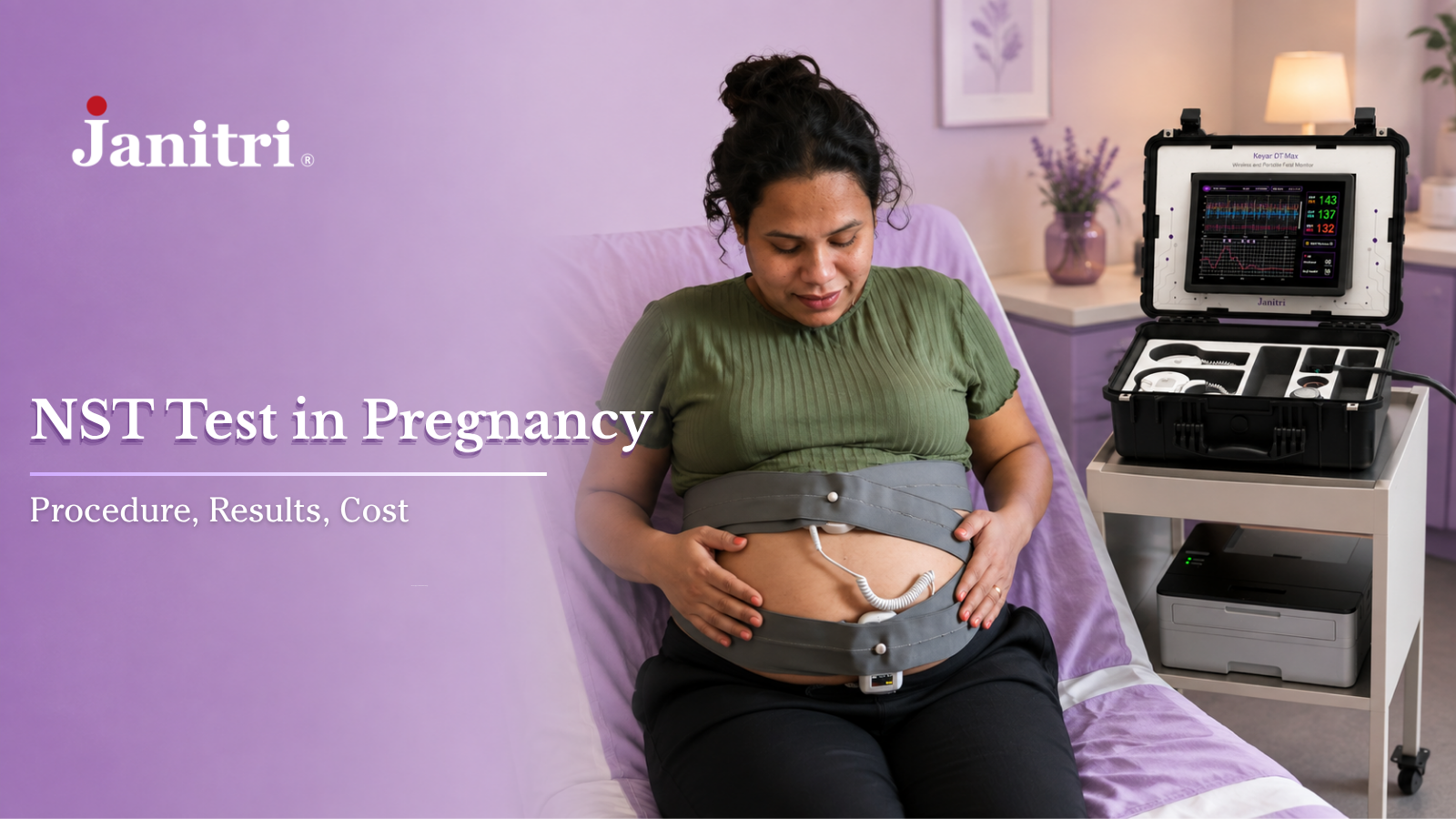
Table of Content
NST Test at a Glance
What Is an NST Test?
Why Is an NST Test Done During Pregnancy?
When Is an NST Test Done?
How Should You Prepare for an NST?
How Is an NST Test Performed?
1. You Get Comfortable
2. Sensors Are Placed
3. Monitoring Begins
4. You Indicate Fetal Movement
5. The Tracing Is Reviewed
How Long Does an NST Test Take?
Is an NST Test Painful?
What Do NST Test Results Mean?
How Is an NST Tracing Interpreted?
NST vs CTG vs Fetal Doppler vs Ultrasound
Is an NST the Same as CTG?
Is an NST the Same as a Fetal Doppler?
Is an NST Scan an Ultrasound?
What Is an NST Machine?
Can an NST Test Be Done at Home?
How Often Is an NST Done?
NST Test Cost in India
What Happens After an NST?
Key Takeaway
Frequently Asked Questions About NST Tests
1. Is an NST test safe during pregnancy?
2. What if my baby does not move during an NST?
3. How often is an NST done?
4. Is NST the same as CTG?
5. Can an NST be done at home?
6. Is an NST an ultrasound?
An NST test (Non-Stress Test) is a non-invasive fetal monitoring test that records your baby's heart rate and evaluates how it responds to movement. It is commonly recommended when your healthcare provider wants to monitor fetal well-being more closely.
An NST is generally painless and usually takes at least 20 minutes. Results are commonly described as reactive or non-reactive, based on the fetal heart-rate pattern observed during monitoring.
This guide explains what an NST test is, why and when it is performed, how the procedure works, what to expect during the test, how NST differs from CTG and other pregnancy tests, and what can affect NST test cost in India.
NST Test at a Glance
Question | Quick Answer |
Full form | Non-Stress Test |
Main purpose | Monitor fetal heart rate and its response to movement |
Typical duration | At least 20 minutes |
Is it painful? | No, generally painless and non-invasive |
Common results | Reactive or non-reactive |
When is it done? | When additional fetal surveillance is indicated |
Where is it performed? | Usually a hospital, clinic or maternity centre |
Who interprets it? | A qualified healthcare professional |
What Is an NST Test?
NST stands for Non-Stress Test. It is a type of fetal surveillance that records your baby's heart rate over a period of time and evaluates changes in the heart rate, particularly in relation to fetal movement.
The test is called a non-stress test because no physical stress is deliberately placed on you or your baby during monitoring.
In simple terms, an NST helps your healthcare team assess whether your baby's heart rate shows a reassuring response during the monitoring period.
An NST provides information about your baby's condition at the time of testing. It does not assess every aspect of pregnancy and is only one part of overall fetal surveillance.
For a detailed explanation of when an NST is done in pregnancy and why your doctor may recommend it, read our guide: When Is an NST Done in Pregnancy and Why?
Why Is an NST Test Done During Pregnancy?
An NST during pregnancy is generally recommended when your healthcare provider believes additional fetal monitoring is appropriate. It is not a test that every pregnant woman routinely needs.
An NST may be considered when there is:
A high-risk pregnancy
Diabetes during pregnancy
High blood pressure or preeclampsia
Concern about fetal growth
Certain multiple pregnancies
Pregnancy continuing beyond the expected due date
Another maternal or fetal condition requiring closer monitoring
The reason for the NST can affect when testing begins and how frequently it is performed.
When Is an NST Test Done?
There is no single pregnancy week when every woman should have an NST.
NST testing is generally used later in pregnancy when additional fetal surveillance is indicated. The timing depends on factors such as:
Why the NST was recommended
Gestational age
Maternal and fetal health
Previous test results
Other findings during pregnancy
Your healthcare provider may recommend an NST once, weekly, twice a week, or at other intervals depending on your individual situation.
How Should You Prepare for an NST?
An NST usually requires little preparation.
Before the test:
Follow any instructions provided by your healthcare team.
Wear comfortable clothing that allows easy access to your abdomen.
Tell your healthcare provider about medications or concerns relevant to your pregnancy.
Follow your provider's instructions about eating, drinking or taking medications before the test.
You will usually sit or recline comfortably during monitoring.
How Is an NST Test Performed?
An NST test is usually simple, painless and non-invasive.
1. You Get Comfortable
You will usually sit in a reclining chair or lie in a comfortable position.
2. Sensors Are Placed
A fetal heart-rate sensor is positioned on your abdomen. Another sensor may be used to detect uterine activity.
The sensors are held in place with monitoring belts.
3. Monitoring Begins
The NST machine records your baby's heart rate during the monitoring period.
4. You Indicate Fetal Movement
You may be given a button to press whenever you feel your baby move. This helps the healthcare professional compare fetal movement with changes in heart rate.
5. The Tracing Is Reviewed
Monitoring usually continues for at least 20 minutes. It may continue longer if your baby is resting or if additional monitoring is needed.
A qualified healthcare professional then reviews the fetal heart-rate tracing.
Want to know exactly what happens during an NST? Read our detailed guide to NST test procedure and what to expect.
How Long Does an NST Test Take?
An NST usually takes at least 20 minutes, although the session may last longer.
If your baby is asleep or does not show enough movement during the initial monitoring period, your healthcare provider may continue monitoring or use other methods to obtain more information.
A longer NST does not automatically mean there is a problem.
Is an NST Test Painful?
No. An NST is generally painless and non-invasive.
What Do NST Test Results Mean?
NST results are generally described as reactive or non-reactive.
The result is based on the fetal heart-rate pattern observed during monitoring. A healthcare professional considers the overall tracing and your clinical situation when interpreting the result.
A reactive NST is generally reassuring, while a non-reactive NST may require continued monitoring or additional assessment.
A non-reactive result does not automatically mean that your baby is in distress. The result should be interpreted by a qualified healthcare professional.
Read the detailed guide: NST Test Results: Reactive vs Non-Reactive Explained
How Is an NST Tracing Interpreted?
You do not need to interpret an NST tracing yourself. A trained healthcare professional evaluates the complete tracing.
The assessment may include:
Baseline: The approximate average fetal heart rate during the monitoring period.
Variability: Natural fluctuations in fetal heart rate around the baseline.
Accelerations: Temporary increases in fetal heart rate.
Decelerations: Temporary decreases in fetal heart rate and their characteristics.
Overall pattern: How these features appear together during monitoring.
These features are interpreted together rather than relying on a single number.
NST traces should be interpreted by appropriately trained healthcare professionals. A single number or isolated feature should not be used to diagnose fetal compromise.
For a detailed explanation, see our guide to how NST traces are interpreted.
NST vs CTG vs Fetal Doppler vs Ultrasound
These tests are related to pregnancy monitoring but provide different types of information.
Test | What it mainly does |
NST | Monitors fetal heart rate and its response to movement |
CTG | Records fetal heart rate and uterine activity |
Fetal Doppler | Detects and allows listening to the baby's heartbeat |
Ultrasound | Creates images and assesses fetal growth, anatomy and other features |
Is an NST the Same as CTG?
Not exactly.
An NST is primarily used for antepartum fetal surveillance, while CTG records fetal heart rate and uterine activity and is also widely used during labour.
The terminology and equipment used can vary between clinical settings.
Is an NST the Same as a Fetal Doppler?
No.
A fetal Doppler can detect the baby's heartbeat. An NST records fetal heart rate over time and evaluates the overall pattern.
A simple way to understand the difference:
Fetal Doppler: Can the heartbeat be detected?
NST: How does the fetal heart-rate pattern respond over time?
Is an NST Scan an Ultrasound?
No.
“NST scan” is a commonly searched term, but an NST is a fetal monitoring test rather than an ultrasound scan.
What Is an NST Machine?
An NST machine is a fetal monitoring device used to record fetal heart rate and, depending on the system, uterine activity.
A typical NST monitoring system may include:
Fetal heart-rate sensor
Uterine activity sensor
Monitoring belts
Display
Recording or data-storage functions
Report-generation features
The machine collects monitoring data, which is then reviewed by an appropriately trained healthcare professional.
Different systems may offer additional features such as digital data storage, connectivity or wireless monitoring.
For detailed information, see our dedicated NST Machine guide.
Can an NST Test Be Done at Home?
In selected cases, home NST monitoring may be possible with appropriate equipment and healthcare-provider guidance.
Traditional NST testing is commonly performed in hospitals, clinics and maternity centres. Connected fetal monitoring technologies may support selected monitoring workflows outside the hospital.
Home monitoring should not be treated as a replacement for professional medical care. Whether it is appropriate depends on the pregnancy, reason for monitoring, equipment and the healthcare provider's instructions.
Read more: How to Perform Non-Stress Test at Home With an NST Machine
How Often Is an NST Done?
There is no universal NST schedule.
Some women may be advised to have an NST once a week or twice a week, while others may require monitoring at different intervals.
The frequency depends on:
The reason for testing
Gestational age
Pregnancy risk factors
Previous NST results
Other maternal or fetal findings
Your healthcare provider will determine the appropriate monitoring schedule for your pregnancy.
NST Test Cost in India
The cost of an NST test in India varies depending on the hospital or clinic, location, type of facility, monitoring duration and whether the NST is included in a broader pregnancy monitoring package.
Before booking an NST, ask the hospital or maternity centre:
What is included in the NST test cost?
How long will the monitoring take?
Is a doctor's consultation included?
Will additional tests be recommended if the NST requires further assessment?
Because prices vary between healthcare facilities and cities, there is no single NST test cost that applies across India. Confirm the current price with the hospital or diagnostic centre before booking.
What Happens After an NST?
After monitoring is complete, a healthcare professional reviews the fetal heart-rate tracing and explains the result.
Depending on the findings, you may be:
Reassured and asked to continue routine care
Asked to return for another NST
Recommended additional fetal monitoring
Recommended an ultrasound or biophysical profile
Given other instructions based on your pregnancy
The next step depends on the complete clinical picture rather than the NST result alone.
Key Takeaway
An NST test is a non-invasive method of monitoring your baby's heart rate and its response to movement. It is commonly used when additional fetal surveillance is needed.
The test usually takes at least 20 minutes and is generally painless. Results are commonly described as reactive or non-reactive, but they should be interpreted by a qualified healthcare professional in the context of your pregnancy.
If your doctor recommends an NST, follow their instructions about when and how often to have the test and what to do after receiving your results.
Frequently Asked Questions About NST Tests
1. Is an NST test safe during pregnancy?
An NST is generally considered a safe, non-invasive fetal monitoring test. Your healthcare provider will determine whether it is appropriate for your pregnancy.
2. What if my baby does not move during an NST?
Your baby may be resting during the monitoring period. Your healthcare professional may continue monitoring, use sound stimulation or recommend additional assessment depending on the result.
3. How often is an NST done?
The frequency depends on why the test was recommended, gestational age, pregnancy risk factors and other clinical findings. Your healthcare provider will determine the appropriate schedule.
4. Is NST the same as CTG?
No. An NST focuses on fetal heart-rate response during monitoring, while CTG records fetal heart rate and uterine activity and is commonly used during labour as well as other clinical situations.
5. Can an NST be done at home?
In selected situations, home NST monitoring may be possible with appropriate equipment and healthcare-provider guidance. It should be part of an appropriate clinical monitoring plan.
6. Is an NST an ultrasound?
No. An NST monitors fetal heart rate, while an ultrasound creates images and can assess fetal growth, anatomy and other features.