Mothers
What Happens If NST Is Non-Reactive?
Apr 24 • 6 min read
Table of Content
Understanding a Non-Reactive NST
What Doctors Do Next if NST Is Non-Reactive
Common Next Steps
Possible Reasons for a Non-Reactive NST
Common Causes Explained
How Long Does It Take to Get a Clear Result?
Tips to Manage Anxiety
When Additional Monitoring Becomes Important
Situations That Require Closer Attention
What happens if NST is non-reactive?
Conclusion
Understanding a Non-Reactive NST
A non reactive test result in a non stress test during pregnancy can understandably cause concern, but it is important to approach it with the right perspective. This result simply means that during the monitoring period, your baby’s heart rate did not show the expected increases (accelerations) in response to movement. These accelerations are usually a reassuring sign that your baby’s nervous system is functioning well and that they are receiving enough oxygen.
However, a lack of these changes does not immediately indicate distress. Babies in the womb follow natural sleep and wake cycles, and it is quite common for them to be less active during certain periods. If your baby happens to be asleep during the test, their heart rate may remain steady rather than showing the typical variations. This is one of the most common reasons for a non-reactive result.
Other temporary factors can also influence the outcome. For example, if the test is performed earlier in pregnancy, the baby’s nervous system may not yet be fully developed to show consistent responses. Similarly, maternal factors such as stress, medications, or even dehydration can affect fetal activity levels.
The key thing to remember is that the NST test in pregnancy is a screening tool. It is designed to flag situations where additional observation may be needed, rather than to diagnose a problem on its own. In many cases, a repeat test later the same day or the next day shows normal results.
What Doctors Do Next if NST Is Non-Reactive
When a non-stress test pregnancy result is non-reactive, healthcare providers follow a structured approach to gather more information. These steps are precautionary and ensure that your baby’s condition is thoroughly evaluated before any conclusions are made.
Common Next Steps
Step | What It Means | Purpose |
Extended NST | Monitoring continues beyond initial duration | Allows time for baby to wake and respond |
Vibroacoustic stimulation | Gentle sound/vibration applied | Stimulates fetal movement |
Repeat NST | Test repeated after some time | Confirms if result was temporary |
Biophysical Profile (BPP) | Combines NST with ultrasound | Evaluates movement, breathing, fluid |
Contraction Stress Test | Observes response to mild contractions | Assesses placental efficiency |
These steps help doctors avoid unnecessary interventions while ensuring that no potential concern is overlooked.
Possible Reasons for a Non-Reactive NST
A non reactive test during a non stress test during pregnancy can occur due to several temporary and often harmless factors. Since the NST captures only a short period of your baby’s activity, the results can vary depending on whether your baby is active, resting, or influenced by external conditions. Understanding these reasons can help reduce anxiety and clarify that a non-reactive result does not always indicate a problem.
Common Causes Explained
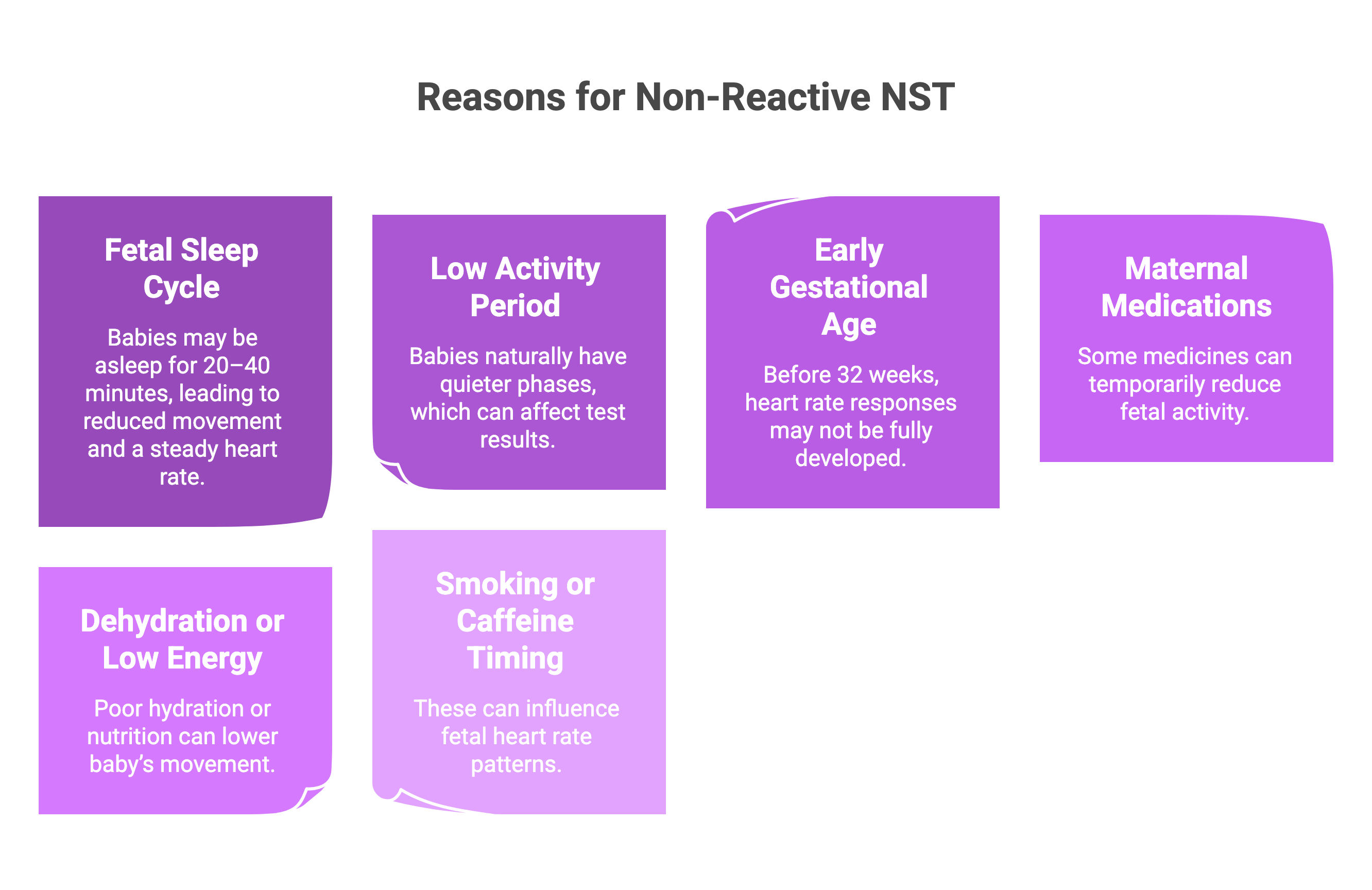
Fetal sleep cycle: Babies may be asleep for 20–40 minutes, leading to reduced movement and a steady heart rate.
Low activity period: Babies naturally have quieter phases, which can affect test results.
Early gestational age: Before 32 weeks, heart rate responses may not be fully developed.
Maternal medications: Some medicines can temporarily reduce fetal activity.
Dehydration or low energy: Poor hydration or nutrition can lower baby’s movement.
Smoking or caffeine timing: These can influence fetal heart rate patterns.
In most cases, these factors are temporary, which is why doctors often repeat or extend the test to get a clearer and more accurate result.
How Long Does It Take to Get a Clear Result?
In many cases, a non stress test during pregnancy becomes reactive with just a little more time. If the baby starts moving during extended monitoring, the result may quickly change to normal. This is why doctors often prefer to continue the test rather than immediately moving to more advanced procedures.
If a repeat test is required, it is usually scheduled within a short interval—sometimes the same day or within 24 hours. This ensures continuous monitoring without causing unnecessary delays.
Emotional Impact and How to Stay Calm
Hearing that your NST pregnancy result is non-reactive can be stressful, especially if you are not familiar with what it means. It is natural to feel anxious, but understanding the context can make a big difference.
Most non-reactive results are not emergencies. They simply indicate that your doctor needs more information. Staying calm during this time is important because stress can also influence your body and indirectly affect the baby’s activity levels.
Tips to Manage Anxiety
Ask your doctor to explain the result clearly
Focus on the fact that follow-up tests are precautionary
Practice slow breathing or relaxation techniques
Avoid jumping to conclusions before further testing
When Additional Monitoring Becomes Important
While many nonstress test reactive results are achieved after repeat testing, there are situations where continued non-reactive findings need closer attention. If more than one non reactive test shows the same pattern, your doctor will want to ensure that your baby is getting enough oxygen and nutrients inside the womb. At this stage, the goal is not to create alarm but to gather more accurate information through careful monitoring.
This may include more frequent NSTs, ultrasound-based assessments, or combined tests like a biophysical profile, which evaluates your baby’s movement, breathing, and fluid levels. These additional checks help doctors understand whether the non-reactive result is due to temporary factors like sleep or something that needs medical attention. If you are close to your due date, your doctor may also discuss early delivery as a precaution to ensure your baby’s safety.
Situations That Require Closer Attention
Repeated non-reactive NST results: Consistent patterns across multiple tests may need further evaluation
Reduced fetal movements: Ongoing decrease in baby’s activity can signal the need for monitoring
Abnormal ultrasound findings: Low fluid levels or reduced movements on scan may raise concern
High-risk pregnancy conditions: Conditions like hypertension or diabetes may require closer tracking
Early detection in these situations allows doctors to make timely and informed decisions, helping ensure the best possible outcome for both mother and baby.
What happens if NST is non-reactive?
A non-reactive NST means the baby’s heart rate did not show the expected increases during movement within the test period. While this may sound concerning, it does not automatically indicate a problem. In many cases, it simply means the baby was less active or in a sleep cycle during the test.
When this happens, doctors usually take a step-by-step approach. The test may be extended to give the baby more time to respond, or it may be repeated later when the baby is more active. Sometimes, gentle stimulation is used to encourage movement. If needed, additional tests such as an ultrasound or a biophysical profile may be recommended to get a clearer picture of the baby’s well-being.
In most situations, a non-reactive result is temporary and resolves with follow-up testing. The main purpose is to ensure that your baby is safe and receiving enough oxygen, so doctors use these results as a guide for closer observation rather than immediate intervention.
Conclusion
A non reactive test result in an NST during pregnancy should be seen as a signal for further observation rather than a cause for immediate concern. In most cases, it is due to temporary factors like fetal sleep or low activity. With proper follow-up and monitoring, doctors can ensure that your baby remains safe and healthy throughout the pregnancy.
FAQ’s
1. What does a reactive NST mean?
A reactive NST means your baby’s heart rate is responding normally to movements, indicating good health.
2. What does a non-reactive NST mean?
A non-reactive NST means the baby’s heart rate did not show expected changes, and further testing or monitoring may be required.
3. What should I do if my NST is non-reactive?
You should immediately consult your doctor. They may recommend repeating the test or conducting additional assessments.
4. Can NST results change over time?
Yes, NST results can vary depending on the baby’s activity, sleep cycle, or health condition.