Mothers
First Month Newborn Care Guide
Jun 2 • 5 min read

Table of Content
What Newborn Care guide Actually Means?
What is Normal in a Newborn?
Normal newborn behaviors
Newborn Feeding Guide
Feeding frequency
Signs your baby is feeding well.
Understanding Newborn Sleep Pattern
Typical sleep pattern
Additional insight:
Safe sleep rules
Umbilical Cord Care
Normal progression:
What parents should do:
Additional note:
Newborn Jaundice
Typical timeline:
When jaundice needs attention
Warning Signs in Newborn care guide
Seek medical help immediately if:
Feeding concerns
Breathing concerns
Temperature issues
Behavioral changes
What Parents Should Focus On Daily
Newborn Care Guide Checklist
Frequently Asked Questions
1. What is the most important newborn care in the first month?
2. How do I know if my newborn is healthy?
3. Is it normal for newborns to sleep all day?
4. When should I worry about jaundice?
5. How many diapers should a newborn have daily?
According to the World Health Organization (WHO), around 2.3 million newborns died globally in 2022, and nearly 47% of all deaths among children under five occur during the newborn period (first 28 days of life), making the first month one of the most critical stages for child survival.
The first 30 days with a newborn care guide are super tough for parents. You are getting better physically trying to feel emotionally and now you are in charge of a tiny person who can't talk.In this time little things feel huge. Like how often your baby eats, sleep patterns, crying, changes in skin colour or and temperature changes can all make you really anxious.
Most parents don't want to read theory. They want to feel reassured and know whats going on:
Is my baby okay?
Am I doing this right?
When should I be worried?
This guide helps make newborn care simple and easy to understand with information that doctors agree on so you can feel confident about what's normal what isn't and what needs attention.
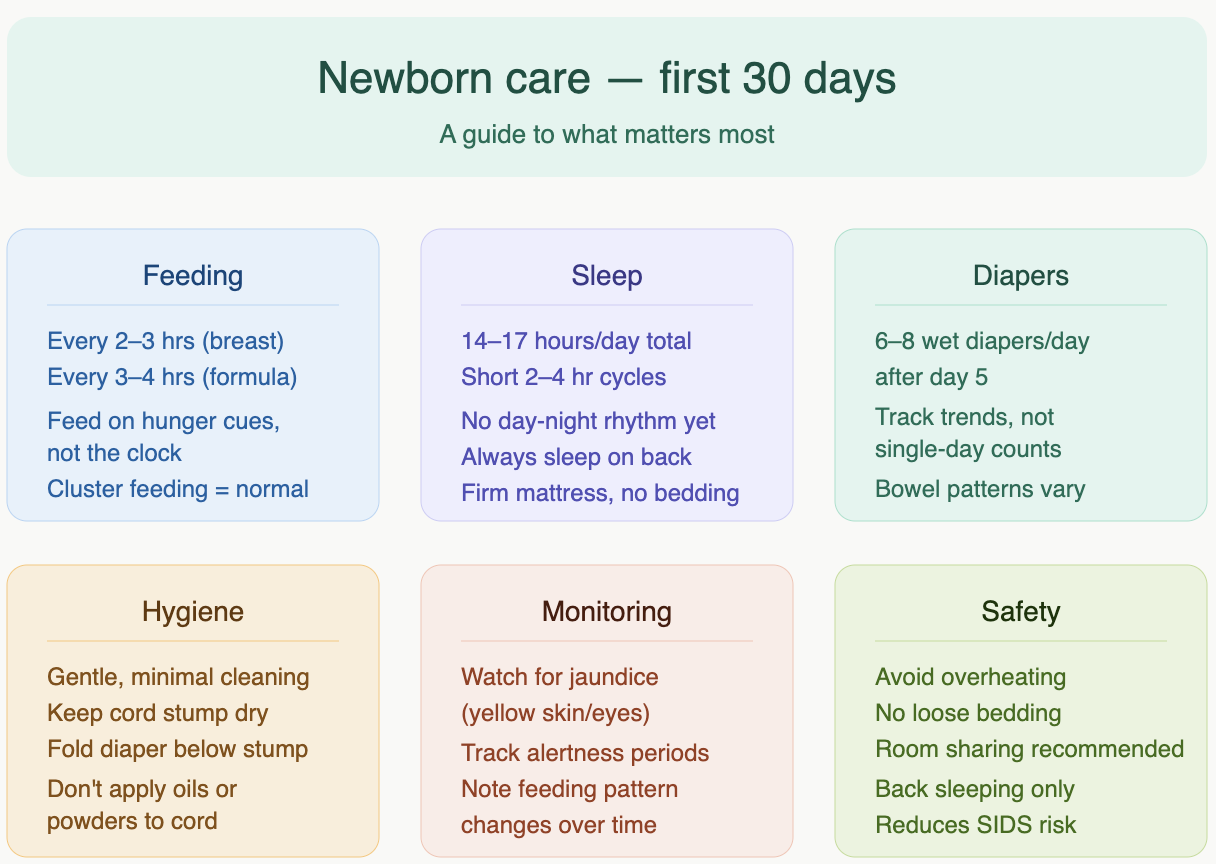
Newborn care in the 30 days is all about feeding often every 2–3 hours making sure your baby sleeps safely keeping them clean tracking diapers watching for jaundice and checking for warning signs like a fever not eating well or trouble breathing. Most things newborns do, like waking up a lot eating a lot at once hiccuping, sneezing and sleeping irregularly are normal and just part of getting used to life outside the womb.
What Newborn Care guide Actually Means?
Newborn Health Monitoring is not a fixed routine. It is continuous responsive care based on observation.
In reality, newborn care is about noticing small patterns:
Is the baby feeding normally today compared to yesterday?
Are wet diapers consistent?
Is the baby alert at times or always sleepy?
Is crying changing in tone or frequency?
Area | What It Actually Means in Real Life |
Feeding | Responding to hunger cues frequently, not strictly timed feeds |
Sleep | Short, fragmented sleep cycles without day-night distinction |
Hygiene | Preventing infection with minimal and gentle cleaning |
Monitoring | Tracking patterns like feeding, urine output, and alertness |
Safety | Avoiding preventable risks like overheating or unsafe sleep |
Newborn care is less about control and more about observation.
What is Normal in a Newborn?
This is the section most parents search for but rarely get explained clearly.
Newborns behave differently because their systems are still developing.
Normal newborn behaviors
Behavior | Normal? | Why It Happens |
Sleeps 14–17 hours/day | Yes | Brain development and energy conservation |
Wakes every 2–3 hours | Yes | Small stomach size and feeding needs |
Cluster feeding | Yes | Growth spurts and milk demand increase |
Mild weight loss after birth | Yes | Fluid adjustment in first week |
Irregular breathing during sleep | Yes | Immature respiratory control |
Hiccups and sneezing | Yes | Developing nervous system reflexes |
Sudden crying spells | Yes | Communication without words |
Important insight: Newborn behavior often looks irregular but is biologically expected.
Newborn Feeding Guide
Feeding is the most critical part of newborn care and the biggest source of anxiety.
Newborn feeding is demand-driven. That means babies eat when they are hungry, not when the clock says so.
Feeding frequency
Feeding Type | Frequency |
Breastfeeding | Every 2–3 hours (sometimes more frequent) |
Formula feeding | Every 3–4 hours |
However, growth spurts can temporarily increase feeding frequency.
Signs your baby is feeding well.
Instead of focusing on timing, focus on outcomes:
6–8 wet diapers per day after day 5
Regular bowel movements (pattern varies by baby)
Steady weight gain after initial drop
Baby releases breast or bottle naturally after feeding
Baby appears relaxed or sleepy after feeds
Cluster feeding is often mistaken as a problem, but it is actually a normal biological response to growth demand.
Understanding Newborn Sleep Pattern
Newborn sleep is fragmented because circadian rhythm has not developed yet.
Typical sleep pattern
Factor | Pattern |
Total sleep | 14–17 hours/day |
Sleep cycles | 2–4 hours |
Deep sleep periods | Short and irregular |
Night waking | Frequent due to feeding needs |
Day-night rhythm | Not yet established |
Additional insight:
Newborns spend more time in light sleep than deep sleep, which is why they wake easily.
Safe sleep rules
Rule | Why It Matters |
Back sleeping | Reduces risk of SIDS |
Firm mattress | Prevents suffocation |
No loose bedding | Avoids airway obstruction |
Room sharing | Improves safety and responsiveness |
Avoid overheating | Helps regulate body temperature |
Umbilical Cord Care
The umbilical cord is one of the most overcomplicated parts of newborn care.
Normal progression:
Starts drying within a few days
Turns dark brown/black
Falls off naturally in 1–3 weeks
What parents should do:
Do | Don’t |
Keep dry and clean | Apply oils, powders, or antiseptics without advice |
Fold diaper below stump | Cover or press tightly |
Let it fall naturally | Try to remove it manually |
Additional note:
A slight odor during drying can be normal, but a strong smell or redness is not.
Newborn Jaundice

Jaundice is one of the most commonly observed newborn conditions.
It occurs due to increased bilirubin levels, which causes yellow discoloration of the skin and eyes.
Typical timeline:
Appears between day 2–5
Peaks around day 3–7
Gradually resolves in most healthy babies
When jaundice needs attention
Sign | Why It Matters |
Yellowing spreading quickly | Rising bilirubin levels |
Poor feeding | Reduced intake slows bilirubin clearance |
Excess sleepiness | Possible higher severity |
Yellowing beyond 2 weeks | Requires evaluation |
Warning Signs in Newborn care guide
This section is essential for search intent and real parental decision-making.
Seek medical help immediately if:
Feeding concerns
Refusal of multiple feeds
Weak sucking or inability to latch
Breathing concerns
Rapid breathing
Chest retractions
Grunting sounds
Temperature issues
Fever in newborn
Abnormally low body temperature
Behavioral changes
Extreme lethargy
Weak, high-pitched, or unusual cry
Baby appears “not like usual self”
In newborn care, early evaluation is always safer than waiting.
What Parents Should Focus On Daily
Most anxiety comes from over-monitoring minor variations.
Instead, focus on:
Feeding consistency over time
Diaper output trends (not single days)
Alertness periods during the day
Breathing comfort
Overall responsiveness
Stability matters more than perfection.
Newborn Care Guide Checklist
Area | What to Do |
Feeding | Every 2–3 hours or on demand |
Sleep | Back sleeping, safe environment |
Diapers | 6–8 wet diapers per day |
Hygiene | Gentle cleaning, avoid overuse of products |
Monitoring | Watch jaundice, feeding, behavior |
Safety | Prevent overheating and unsafe sleep practices |
Conclusion
Newborn Care Fact | Statistic |
|---|---|
Global newborn deaths (2022) | 2.3 million |
Deaths occurring in first week | ~75% |
Babies dying daily in first month | ~6,300 |
Under-5 deaths occurring in newborn period | 47% |
Neonatal mortality rate (2022) | 17 per 1,000 live births |
Newborn care guide is not about perfection it is about understanding patterns, staying observant, and responding calmly when something changes.
Most concerns in the first 30 days are part of normal newborn adaptation, not illness.
If you remember only three principles:
Feed based on cues, not rigid timing
Ensure safe sleep at all times
Watch for warning signs, not every variation
Everything else becomes easier with experience.
Frequently Asked Questions
1. What is the most important newborn care in the first month?
Feeding, safe sleep, hygiene, and monitoring for warning signs are the most important aspects.
2. How do I know if my newborn is healthy?
Regular feeding, adequate wet diapers, steady weight gain, and alert periods are positive indicators.
3. Is it normal for newborns to sleep all day?
Yes. Newborns typically sleep 14–17 hours in short cycles.
4. When should I worry about jaundice?
If yellowing increases, feeding reduces, or baby becomes very sleepy, consult a doctor.
5. How many diapers should a newborn have daily?
Around 6–8 wet diapers per day after the first few days.