Hospitals
What Is a Good Apgar Score for Your Baby? A Complete Guide for Parents
Apr 10 • 6 min read

Table of Content
What Is the Apgar Score? (Apgar Score Meaning)
The Apgar Score Chart: 0 to 10 Explained
What Does the Apgar Score Measure and What It Doesn't
Apgar Score Ranges: What Is a Good Apgar Score for a Baby?
Is Apgar score 8 good?
Apgar Score 4 to 6 — Moderately Low
What Is a Low Apgar Score?
Apgar Score at 1 Minute vs. 5 Minutes: What's the Difference?
My Baby Had a
Does a Low Apgar Score Affect Baby Long Term?
A Note for Parents: What You Can Do
Frequently Asked Questions (FAQs)
Those first few minutes after your baby is born can feel like the longest of your life. You're exhausted, emotional, and waiting desperately for the sound of a cry. And then, almost immediately, someone in scrubs is assigning your newborn a number. What does it mean? Is it good? Should you be worried?
Take a breath. This guide will walk you through everything you need to know about the Apgar score, what it measures, what's considered normal, and what happens if your baby's score is low.
What Is the Apgar Score? (Apgar Score Meaning)
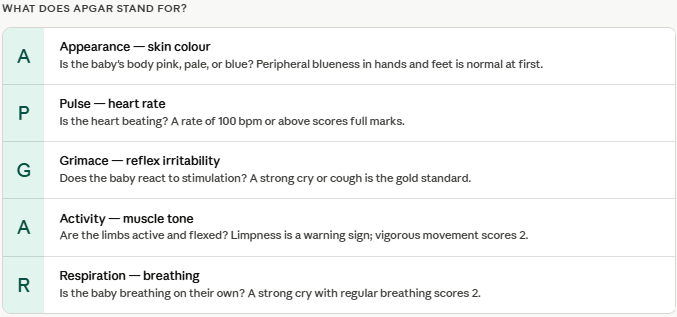
The Apgar score is a quick, standardized assessment used by doctors, nurses, and midwives to evaluate the health of a newborn baby immediately after birth. It was developed in 1952 by Dr. Virginia Apgar, an American anesthesiologist, and remains one of the most widely used newborn assessments in the world today.
Think of it as your baby's very first health check a rapid snapshot of how well they are adapting to life outside the womb.
The name APGAR also conveniently doubles as an acronym for the five criteria it measures:
Letter | Criterion | What's Being Observed |
A | Appearance (Skin Color) | Is the skin pink, blue, or pale? |
P | Pulse (Heart Rate) | How fast is the heart beating? |
G | Grimace (Reflex Irritability) | Does the baby respond to stimulation? |
A | Activity (Muscle Tone) | Are the limbs active and flexed? |
R | Respiration (Breathing) | Is the baby breathing and crying? |
The Apgar Score Chart: 0 to 10 Explained
The Apgar score quickly evaluates a newborn’s health right after birth using five key signs appearance, pulse, reflex response, activity, and breathing. Each is scored 0–2, with a total up to 10, helping doctors assess if immediate medical care is needed.
Criterion | Score 0 | Score 1 | Score 2 |
Appearance | Blue/pale all over | Blue extremities, pink body | Completely pink |
Pulse | Absent (no heartbeat) | Below 100 bpm | 100 bpm or above |
Grimace | No response | Grimace or weak cry | Strong cry, cough, or sneeze |
Activity | Limp, no movement | Some limb flexion | Active, flexed limbs |
Respiration | Absent | Weak, irregular | Strong cry, good breathing |
What Does the Apgar Score Measure and What It Doesn't
The Apgar score is designed to quickly flag whether a newborn needs immediate medical support. It measures immediate physiological adaptation at birth essentially, how well your baby is doing in the first moments of life.
What it does measure: heart and lung function in the immediate newborn period, neurological responsiveness at birth, and whether the baby needs resuscitation or additional support.
What it does not measure: long-term intelligence or development, the risk of future medical conditions, or anything related to your prenatal care.
Apgar Score Ranges: What Is a Good Apgar Score for a Baby?
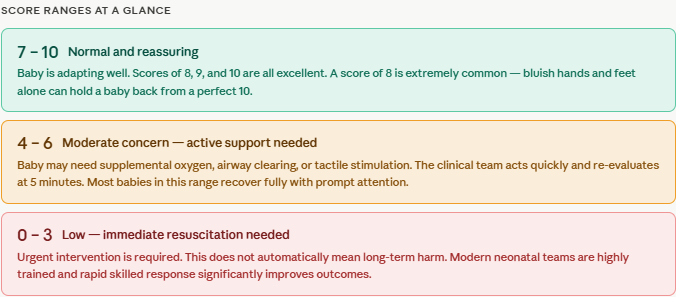
Apgar Score 7, 8, 9, 10 — Normal and Healthy
A score of 7 or above at 5 minutes is considered normal and reassuring. Most babies score between 7 and 10, indicating good health and healthy adaptation to the outside world.
Score 8–10: Excellent. Baby is vigorous, breathing well, and has a strong heartbeat. No immediate intervention needed.
Score 7: Still within the normal range. Baby may need minor support such as gentle stimulation or supplemental oxygen, but is generally doing well.
Is Apgar score 8 good?
Yes — absolutely. Many babies score 8 because their hands and feet remain slightly blue (acrocyanosis), which is completely normal and resolves on its own within minutes. Is a baby Apgar score of 9 normal? Yes — it's one of the most common scores. A score of 10 is possible but relatively rare.
Apgar Score 4 to 6 — Moderately Low
A score of 4 to 6 indicates moderate concern. The baby may need active medical support such as supplemental oxygen, tactile stimulation, or airway clearing. Medical staff will act quickly and re-evaluate at 5 and 10 minutes. A score of 6 means your baby needs some help right now but with prompt attention, most babies recover quickly and go on to be perfectly healthy.
What Is a Low Apgar Score? (Score 0 to 3)
A score of 0 to 3 is considered low and signals that the baby needs immediate resuscitation including bag-mask ventilation, cardiac compressions if needed, and possible NICU transfer. A low Apgar score does not automatically mean long-term harm, but it requires urgent intervention.
Apgar Score at 1 Minute vs. 5 Minutes: What's the Difference?
The 1-minute Apgar is taken immediately after birth. It reflects what the baby experienced during labor and delivery including the stress of the birth process itself. Many babies who score low at 1 minute improve dramatically within a few minutes on their own or with simple support.
The 5-minute Apgar is more clinically meaningful. It tells the care team how the baby is responding to any interventions and how effectively they are stabilizing. A baby who scores 5 at 1 minute but 8 at 5 minutes is, in most cases, doing well.
If the score at 5 minutes is still below 7, the assessment is repeated at 10 minutes and sometimes beyond.
Timepoint | Purpose | Clinical Significance |
1 minute | Snapshot of birth experience | Guides immediate care decisions |
5 minutes | Response to initial care | More predictive of outcomes |
10+ minutes | Ongoing monitoring | Used for babies requiring continued support |
My Baby Had a Low Apgar Score is that Okay?
This is the question every parent desperately wants answered and the honest answer, backed by evidence, is: most likely, yes.
The majority of babies with low 1-minute scores recover fully. The 1-minute Apgar captures the stress of birth long labors, emergency C-sections, cord complications which can temporarily depress the score without causing lasting harm. If a baby's score improves to 7 or above by 5 minutes, the prognosis is generally very good. What matters most is the care your baby receives in those first minutes. Modern neonatal teams are highly trained in newborn resuscitation, and immediate skilled intervention significantly improves outcomes.
Be open with your care team. Ask them to explain your baby's scores, what they observed, and what the follow-up plan looks like.
Does a Low Apgar Score Affect Baby Long Term?
For most babies, a low 1-minute score with good recovery by 5 minutes has no significant long-term implications. The baby will grow, develop, and thrive normally.
For babies with persistently low scores are especially below 5 at 5 and 10 minutes there is an association, not a certainty, with a higher risk of neurological conditions. It is important to note that a low Apgar score alone is not a diagnosis of any condition, and many babies who score poorly at birth go on to have entirely typical development.
Some parents worry about a connection between low Apgar scores and cerebral palsy. While birth asphyxia is one cause of cerebral palsy, the American Academy of Pediatrics (AAP) has explicitly stated that the Apgar score alone should not be used to diagnose birth asphyxia or predict long-term neurological outcomes. Most children with cerebral palsy were not born with low Apgar scores, and additional assessments are blood gas analysis, MRI, and neurological examination are always required to evaluate further.
A Note for Parents: What You Can Do
If your baby received a low Apgar score:
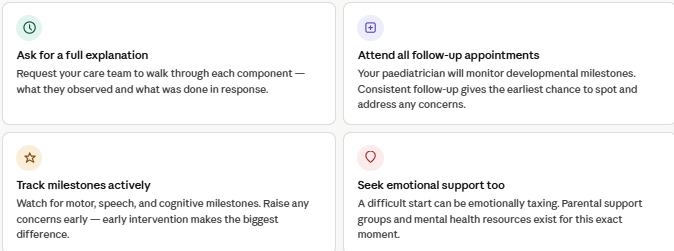
Ask questions. Request a clear explanation of each component and what interventions were taken.
Attend all follow-up appointments. Your paediatrician will monitor developmental milestones closely.
Track development. Watch for milestones in motor skills, speech, and cognition, and raise any concerns early.
Seek support. Parenting a baby who had a difficult start can be emotionally taxing. Reach out to your healthcare team or parental support communities.
Trust the process. The Apgar score is the beginning of the conversation, not the end.
Frequently Asked Questions (FAQs)
Q: What is a good Apgar score for a baby? A score of 7 or above at 5 minutes is considered normal and healthy. Scores of 8, 9, and 10 are all excellent outcomes.
Q: What does an Apgar score of 6 mean? A score of 6 means the baby needs some support — such as supplemental oxygen or stimulation — but is not in a critical condition. Most babies with a score of 6 improve quickly with prompt care.
Q: Can a low Apgar score cause long-term problems? A low 1-minute score that improves by 5 minutes rarely causes long-term issues. Persistently low scores are associated with a higher (though not certain) risk of neurological conditions and warrant follow-up care.
Q: Why is the 5-minute Apgar score more important than the 1-minute score? The 1-minute score reflects the stress of the birth process. The 5-minute score shows how well the baby is responding to care and is a better predictor of outcomes.